







After Laying Off 40% of Staff, Twitter Co-founder to Give Away $1 Million in Bitcoin
“Faucet” is a very old term in the 暗号 industry and a very old way of doing things: receiving tokens for free into a wallet. This culture dates back to 2010, when Bitcoin was less than two years old, worth only a few cents per coin, almost unknown to the world, and no one knew what it would later become.

Early developer Gavin Andresen, sitting at his computer, used his own BTC to set up a simple webpage. He was one of the core developers in Satoshi Nakamoto’s early circle, ranking high in code contributions. But he created this page not for project promotion or fundraising storytelling. He simply believed that for this network to survive, more people needed to truly hold Bitcoin and experience this peer-to-peer payment network firsthand, rather than just discussing it on mailing lists.
The page’s logic was straightforward: you come, solve a CAPTCHA, 5 Bitcoins go into your wallet, done. No minimum purchase requirement, no account binding, no additional conditions. Anyone could visit, claim, and leave.
That page ran for several months. Andresen kept supplying it with his own BTC until it was nearly depleted, then shut it down. He gave away a total of approximately 19,700 BTC.
At today’s price of around $67,000, that’s about $1.3 billion.
This “faucet” culture has never left the crypto industry.
“The Faucet Is Back”
Returning to Jack Dorsey, we all know he is the co-founder of Twitter (now X), but in recent years he has completely shifted his focus to Block, formerly Square, a fintech company with Bitcoin as its core strategy.
Block’s main products include:
– Cash App: A mobile payment and Bitcoin purchasing platform for general users;
– Square: Payment terminals and payment processing systems for merchants;
– Bitkey: Block’s self-developed Bitcoin hardware wallet, focusing on self-custody;
– Proto Rig: A modular Bitcoin miner launched by Block in August 2025;
Jack Dorsey himself is a staunch Bitcoin believer, having publicly stated: “Bitcoin will become the native currency of the internet, and fiat currency will die in the future.” All his business moves revolve around this belief.
Returning to Block’s event itself, we can see the rewards on the page are divided into three tiers: Purchase over $10 worth of BTC on Cash App, get $5 in BTC back; Pay a Square merchant with Bitcoin, get $25 in BTC back; Withdraw BTC to a Bitkey hardware wallet, get $50 in BTC back.

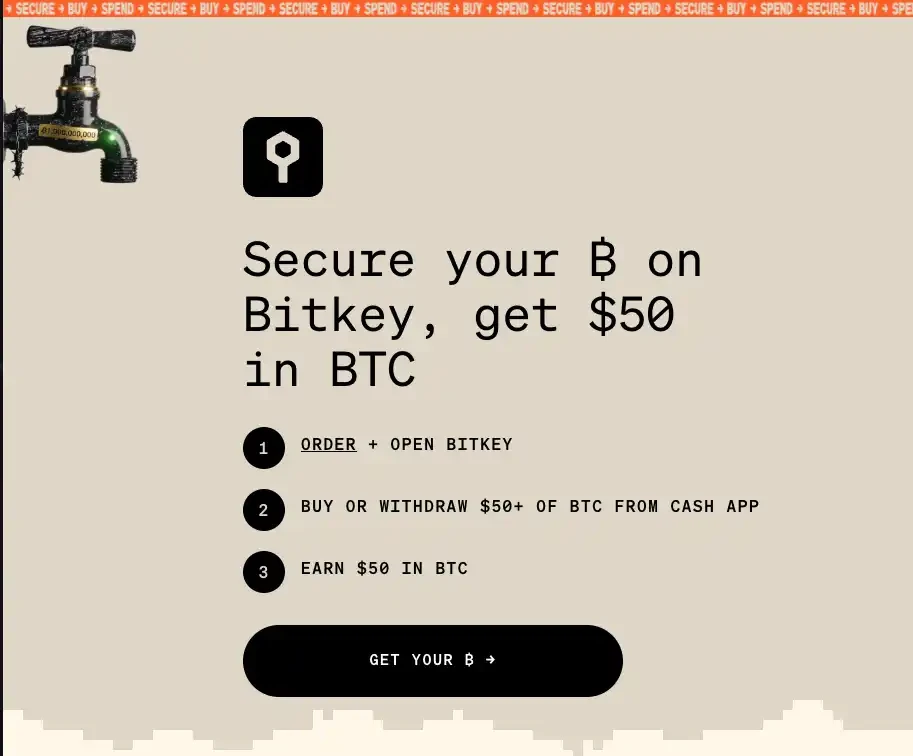
btc.day event page
Complete all three tasks, and you can get up to $80 worth of BTC.
The total reward pool is $1 million. The event ends on April 10th, first-come, first-served, while supplies last, and is limited to U.S. residents aged 18 and over. There’s one detail in the terms: Residents of New York State can buy BTC on Cash App, but they cannot claim the rewards for the Square payment and Bitkey withdrawal tiers. New York’s crypto licensing rules block these two actions.
Looking at the three reward tiers side by side, the structure is clear. Each reward tier corresponds to a specific product line within Block’s ecosystem:
The $5 tier activates the user’s first BTC purchase action within Cash App, establishing a purchasing habit;
The $25 tier encourages users to try spending Bitcoin at physical merchants, promoting actual Bitcoin circulation within the Square merchant network;
The $50 reward is the highest, incentivizing users to transfer Bitcoin to their self-controlled Bitkey hardware wallet, promoting the concept of self-custody. This is precisely the step Block most wants to advance.
What Block gets for $1 million is deep, real-world experience from a large number of users across its three product lines, which is more cost-effective than any advertisement.
The event was launched when Bitcoin was priced around $67,000, a nearly 50% correction from the peak of $126,000 at the end of 2025. Taking the initiative to launch a “free BTC giveaway” event during a period of low market sentiment can attract hesitant users on one hand, and on the other hand, signal Block’s firm confidence in Bitcoin’s long-term value to the market.
Furthermore, this aligns with Jack Dorsey’s vision of inclusive finance. Dorsey has long advocated that Bitcoin is not just an investment tool but also a financial tool for ordinary people in emerging markets to bypass the traditional banking system. Bitcoin Day is a practical implementation of this idea, lowering the entry barrier and allowing more people to truly “hold” Bitcoin for the first time.
The Radically Transformed Block
And the Block making this decision is a company that has been thoroughly transformed.
On February 26, 2026, Block announced layoffs of approximately 4,000 employees, representing 40% of its total workforce, reducing from 10,000 to under 6,000. After the layoff announcement, the stock price rose from the $50s to nearly $90.
In an internal letter, Jack Dorsey wrote that he wanted the company to be “uncomfortably lean.” During the same period, the company’s internal AI tool, Goose (built on the Model Context Protocol), was already responsible for about 90% of code commits.
Prior to this downsizing, Block also shut down its long-running decentralized web project, TBD, freeing up resources to fully commit to Bitcoin mining machines and the Bitkey ecosystem. In August 2025, Block launched Proto Rig, a modular Bitcoin miner, aiming to break Bitmain’s roughly 80% market share, accompanied by the open-source mining farm management software Proto Fleet.
Block currently holds 8,883 BTC, with an average purchase cost of around $33,000 per coin, representing an unrealized gain of about 103%. BTC is currently around $67,000, having fallen by nearly half from the peak of $126,000 at the end of 2025. Jack Dorsey did not sell at the peak, nor has he stopped betting.
Community and 市場 Reaction
After the event was announced, the cryptocurrency community generally reacted positively, viewing it as a “return to Bitcoin’s original spirit.” Analysts pointed out that the launch of Bitcoin Day might trigger a significant increase in BTC purchase volume within Cash App around April 6th, potentially causing short-term trading volume fluctuations.
However, there has also been criticism, focusing on: the reward cap being only $80, offering limited appeal to true “newcomers”; participation requiring an existing Cash App account, completely excluding non-U.S. users; and the event being essentially a customer acquisition marketing campaign for Block’s own products, differing from the purely altruistic nature of Andresen’s original effort.
But most observers believe that acquiring real product experience from hundreds of thousands of users for $1 million is a highly cost-effective marketing move for Block.
Going back 16 years, when Andresen shut down his page, he didn’t know those 19,700 coins would be worth so much. What he did, in today’s terms, is called “user acquisition,” but his motivation back then wasn’t a business model; it was belief. He believed the Bitcoin network needed real participants. All he could give was his own Bitcoin, so he gave it away.
The result was that over a few months, thousands of strangers owned Bitcoin for the first time—not bought, but given. This is precisely the core spirit Dorsey’s event draws from.
Jack Dorsey’s Bitcoin Day event is an expression of belief spanning history and the present. It replants the seed of “changing the world with free Bitcoin” from 16 years ago into the commercial soil of Block.
この記事はインターネットから得たものです。 After Laying Off 40% of Staff, Twitter Co-founder to Give Away $1 Million in Bitcoin
Related: Power, Warfare, and the Crypto Survival of Middle Eastern Civilians
Original Author: Hazel Original Source: Zhiwu Buyan In the early hours of June 18, 2025, while tens of millions of Chinese were staying up late to snap up discounted goods, Iran’s largest cryptocurrency exchange, Nobitex, was also “liquidated.” A hacker group called Gonjeshke Darande, which means “Predatory Sparrow” in Persian, posted on X, claiming they had breached Nobitex’s hot wallets and taken over $90 million. Just the day before, this same group had attacked Bank Sepah, one of Iran’s largest state-owned banks. Then, they did something rarely seen in the history of hacking. They transferred the entire $90 million into eight “black hole addresses” to be destroyed. These wallets have no private keys; once funds are sent in, they can never be retrieved. Ironically, these addresses all contained embedded phrases…
相关文章































 日本語
日本語  English
  繁體中文
繁體中文  简体中文
简体中文  Tiếng Việt
  العربية
  한국어
한국어  Bahasa Indonesia
  हिन्दी
  اردو
اردو  Русский