







The Real Test for the Crypto Industry: How the 2026 Midterm Elections Will Determine Legislative Fate
Original Author: David Christopher, Bankless
Original Compilation: Peggy, BlockBeats
Editor’s Note: The 2026 U.S. midterm elections could become a key variable determining the direction of the 暗号 industry.
From an outcome perspective, prediction markets generally believe the Democratic Party has a high probability of retaking the House of Representatives, and it’s not impossible they could control both the House and Senate. Should this scenario occur, control of key congressional committees would shift accordingly, with Maxine Waters and Elizabeth Warren leading the House Financial Services Committee and the Senate Banking Committee, respectively.
However, what truly demands attention is not “who supports crypto,” but “who controls the agenda.”
Based on a cross-analysis of prediction markets, candidate stances, and congressional structure, this article points to an underestimated risk: even as bipartisan support is forming, such support holds almost no practical significance if it cannot enter the committee process. Control over hearings, deliberations, and scheduling allows committees to directly decide the fate of a bill without a full vote.
Structurally, this is the core contradiction at present: although a significant proportion of Democratic lawmakers have shifted to support crypto on specific bills, this support has not translated into dominance at the committee level. In the stages that truly determine legislative fate, the overall landscape still leans cautious or even oppositional.
With the potential power reshuffle brought by the midterm elections, the crypto industry faces not just short-term policy fluctuations, but a deeper institutional uncertainty: the path to regulatory clarity could be interrupted before it truly begins.
Therefore, a relatively clear scenario judgment can be formed: under the baseline scenario, regulatory progress will enter a period of stagnation; in a more pessimistic scenario, core legislation such as stablecoins and market structure could be completely deadlocked, with short-term policy tailwinds nearly zero.
The following is the original text:
Just how bad could these midterms be for crypto? As the odds of a Democratic sweep of the House and Senate continue to rise, I wanted to take a closer look at what the current polling is actually telling us and what it means for the future of crypto.
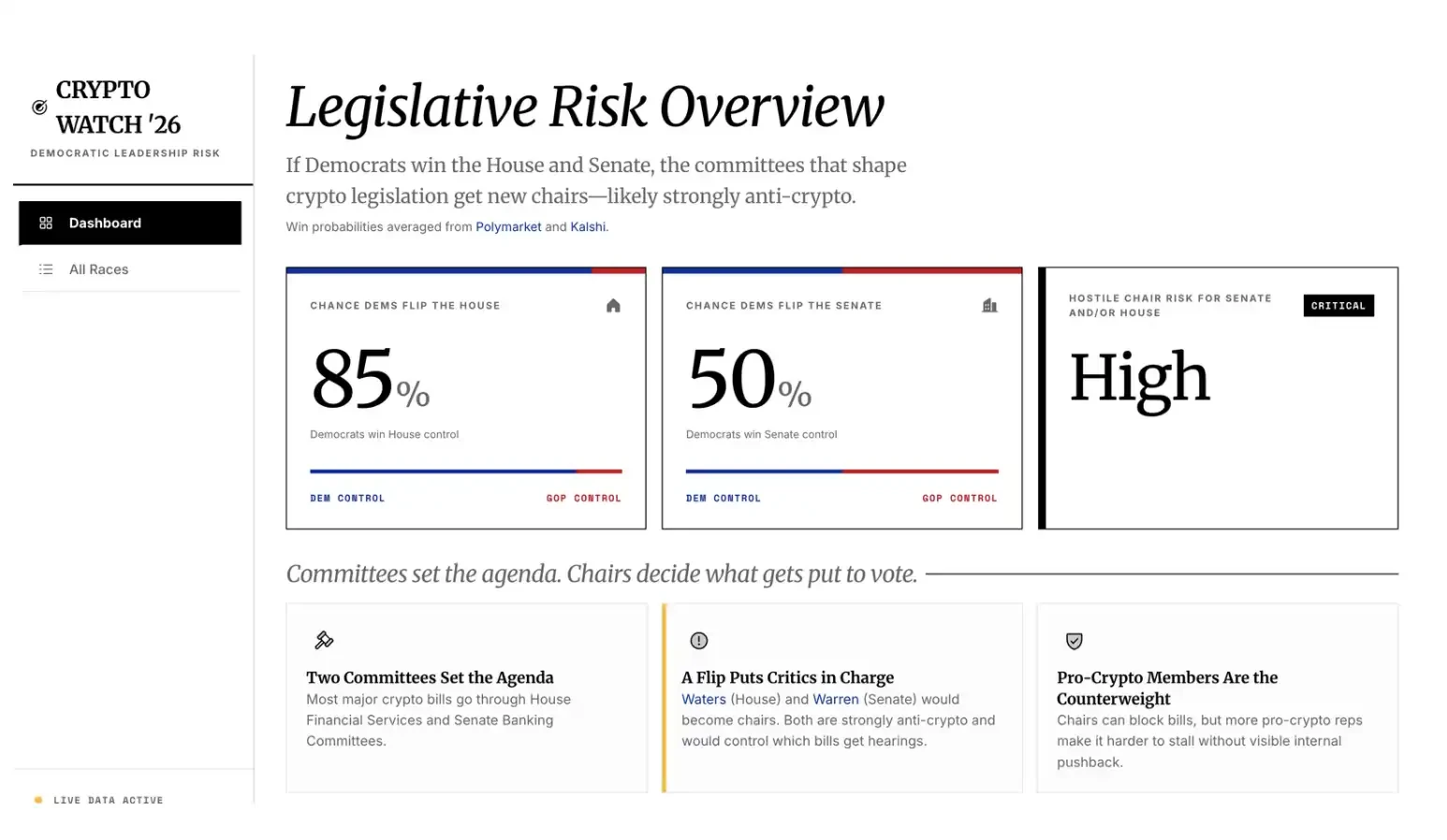
To do this, I looked at prediction market data and databases like Stand with Crypto (SWC) that track candidates’ positions on crypto. While pulling this information together, I also built a dashboard: I took the data, built the front end with Cursor, connected the logic with Claude Code, and deployed it on Vercel.
While the data is still being filled in, I’ve built a database tracking districts where Democratic candidates are leading, mapping them to their positions on crypto and the congressional committees they might join. This gives me an initial sketch of the policy landscape for the coming months: seemingly workable on the surface, but with deeper structural issues lurking beneath.
One Surprising Thing
First, there’s more support for crypto within the Democratic Party than you might think—at least on specific bills.
In the House, 101 Democrats (about 48% of the caucus) voted for the GENIUS Act; in the Senate, 18 Democrats (about 40%) voted to advance it. This does form a bipartisan coalition of support. But that support is bill-by-bill, and it falls apart once you get to the committee stage, where legislation actually moves.
And that’s the problem.
Where the Power Is
Crypto legislation never goes straight to the floor.
Whether it’s stablecoins, market structure, or SEC jurisdiction, everything has to go through committee first. The House Financial Services Committee (HFSC) and the Senate Banking Committee are the two key venues where crypto bills live or die (market structure bills also need the Agriculture Committee for the CFTC piece). The chair decides what gets a hearing, what gets a markup, and what gets quietly dragged into procedural purgatory. If the chair opposes a bill, they don’t even have to call a vote—they can just not schedule it.
The last few Republican chairs have shown how that power can be used to move legislation forward. For example, Senate Banking Chair Tim Scott moved the GENIUS Act through committee and shepherded it through the Senate; former HFSC Chair Patrick McHenry led FIT21, the first major crypto market structure bill to pass the House. Current Chair French Hill has continued that momentum, moving related legislation (including the CLARITY Act, though it’s currently stalled in the Senate) and holding hearings on digital assets and capital markets modernization.
What Happens if Democrats Sweep?
In the U.S. Congress, the majority party controls all committee chairs. No exceptions.
If Democrats take the House, they’ll chair all House committees; if they take the Senate, they’ll chair all Senate committees. And within the majority party, chairs are typically assigned by seniority.
On the House Financial Services Committee, the most senior Democrat is Maxine Waters; on the Senate Banking Committee, it’s Elizabeth Warren. Both are famously opposed to virtually every major crypto bill. Warren opposed the GENIUS Act on national security grounds during its markup, and Waters has called it a full-on crypto scam.
More importantly, there’s a House-specific dynamic: when party control flips, all subcommittees get reshuffled. The majority party not only determines the ratio of seats but also influences freshman assignments. Waters would have significant influence over the composition of the Financial Services Committee (HFSC) and its subcommittees, including who leads the Digital Assets Subcommittee. While she can’t unilaterally decide all assignments (party leadership and the caucus are involved), she can certainly steer the overall structure toward a more crypto-skeptical alignment.
And in fact, the current Democratic membership on HFSC is already skewed toward crypto critics like Brad Sherman, Stephen Lynch, Emanuel Cleaver, and Sylvia Garcia. While there are crypto-supportive Democrats like Jim Himes, Bill Foster, Ritchie Torres, Josh Gottheimer, and Vicente Gonzalez who can provide some counterbalance, they don’t control the agenda under a Waters chairmanship.

The Senate: Slightly Better, but Still Constrained
The Senate Banking Committee is a less dire picture. Under an Elizabeth Warren chair, the committee would have a mixed structure: relatively crypto-supportive members like Mark Warner, Ruben Gallego, and Angela Alsobrooks, alongside clear opponents like Tina Smith and some more swing-y votes.
There’s a marginal bright spot: if Democrats take the Senate, Gallego—who scores well on Stand with Crypto (SWC)—would likely chair the Digital Assets Subcommittee. While Warren would still control the committee’s overall agenda, Gallego could at least carve out some space for crypto-friendly voices at the subcommittee level.
The Real Action Is in These Seats
A more practical problem: most crypto-supportive Democrats aren’t on the House Financial Services Committee (HFSC) or the Senate Banking Committee.
They can vote yes on the floor, and they can apply some pressure to party leadership (though in today’s increasingly partisan crypto environment, most won’t stick their necks out). But what they can’t do is force a committee chair to move legislation.
So the elections that will actually shape crypto policy are the handful of key races that will change committee composition—and determine whether bills get discussed, not just voted on.

The Midterms Takeaway
The House outlook is, frankly, grim.
If you put an 85% probability on Democrats flipping the House, a Maxine Waters chairmanship of the Financial Services Committee (HFSC) is almost a certainty. She’d not only reshuffle subcommittee seats but also control the agenda. The bright spots are limited—Menefee potentially replacing Green, Gonzalez holding his seat—and they provide only marginal counterbalance, not a change in who holds the gavel.
The Senate is the remaining battleground, but the picture got worse last night.
In the Illinois primary, Juliana Stratton defeated Raja Krishnamoorthi. Between her SWC score and the $7 million Fairshake spent against her, Stratton is firmly in the anti-crypto camp.
And that’s the frustrating part of the overall structure: crypto-supportive Democrats do exist. About 47% of House Democrats supported the GENIUS Act, and 37% supported the CLARITY Act. But the problem is—bills don’t live or die on the floor.
They live or die in committee. And on committee votes for market structure, it’s almost entirely party-line. The support that exists isn’t translating into power where it matters.
Crypto shouldn’t be this partisan. Crypto-supportive Democrats exist—they just don’t hold the gavels.
This dashboard is still a work in progress, and I’ll be updating it over the coming weeks and months. But even with incomplete data, the overall picture is clear enough: the House is likely to be the roadblock, and the Senate is the only real place to focus.
この記事はインターネットから得たものです。 The Real Test for the Crypto Industry: How the 2026 Midterm Elections Will Determine Legislative Fate
Starknet Project Twitter: https://twitter.com/Starknet Project Website: https://starknet.io/ This Unlock Amount: 127 million tokens This Unlock Value: Approximately $4.84 million USD Starknet is an Ethereum Layer 2 solution that utilizes zk-STARKs technology to make Ethereum transactions faster and cheaper. Its parent company, StarkWare, was founded in 2018 and is headquartered in Israel. Its main developed products include Starknet and StarkEx. By using STARK proofs, Starknet validates transactions and computations without requiring all network nodes to verify every operation. This significantly reduces the computational burden and increases the throughput of the blockchain network. The specific release schedule is as follows: This article is sourced from the internet: Weekly Token Unlocks: STRK’s Unlock Volume This Week Accounts for 4.4% of Circulating SupplyRelated: A Brief History of Silicon Valley’s Myth-Making: Moltbook, Cyber Mirage, and…
相关文章































 日本語
日本語  English
  繁體中文
繁體中文  简体中文
简体中文  Tiếng Việt
  العربية
  한국어
한국어  Bahasa Indonesia
  हिन्दी
  اردو
اردو  Русский