







On March 1st, Iranian missiles and drones struck the Gulf region, with one landing on an Amazon data center in the UAE.
The data center caught fire, lost power, and approximately 60 cloud services were disrupted.
Claude, one of the world’s most widely used AIs, runs on Amazon’s cloud. On the same day, Claude experienced a global outage.
Anthropic’s official explanation was a surge in users overwhelming the servers.
As of publication, social media still has complaints about Claude service being unavailable; on the well-known prediction market Polymarket, a prediction topic “How many more times will Claude go down in March?” has already appeared.

If it is ultimately confirmed that Iran was responsible, this would be the first time in human history:
A commercial data center was physically destroyed in a war.
But why would a civilian data center be bombed?
Rewind two days. On February 28th, the US and Israel jointly launched an airstrike on Iran, killing Supreme Leader Khamenei and a group of senior officials.
A significant portion of the intelligence analysis, target identification, and battlefield simulation for this airstrike was done with the help of Claude. Through collaboration between the military and data analytics company Palantir, Claude had long been integrated into the US military’s intelligence systems.
Ironically, just hours before the airstrike, Trump had ordered a complete ban on Anthropic because Anthropic refused to hand over its AI to the Pentagon without restrictions. But the ban was one thing, the war still had to be fought.
Publicly, it was said that extracting Claude from the military systems would take at least six months.
So before the ink on the ban was dry, the US military went to bomb Iran with Claude. Then Iran retaliated, and a missile landed on the data center running Claude AI.

Image source: Bloomberg
The data center was most likely not the intended target, just collateral damage. But regardless of whether the missile was aimed at the data center, one thing is certain:
Truth lies within the range of artillery, and AI lies within the range of artillery as well. Both the side firing the artillery and the side being hit by it.
The Great AI Infrastructure, Built on the Middle East Powder Keg
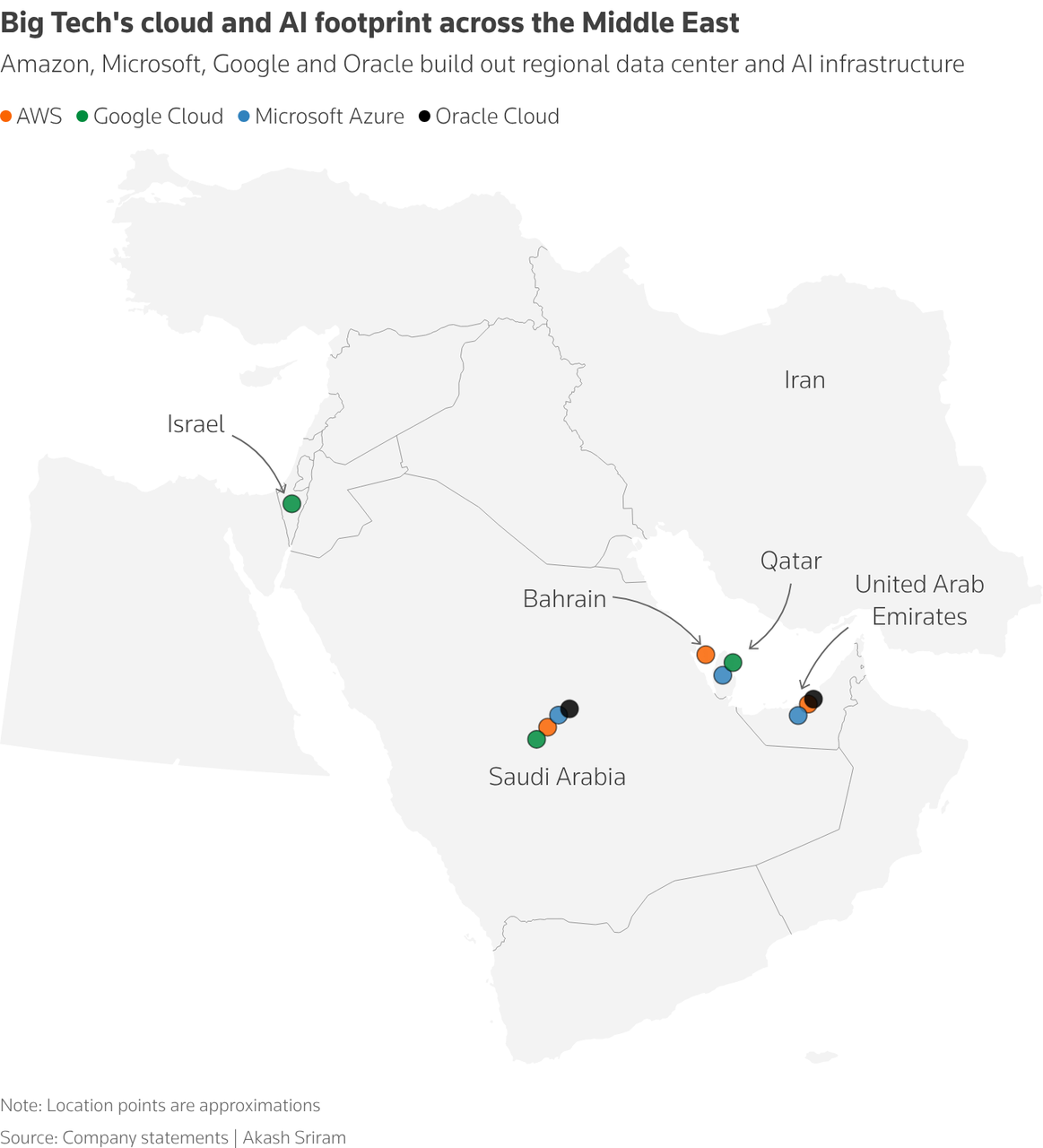
Over the past three years, Silicon Valley has moved half of the AI industry to the Middle East Gulf.
The reason is simple. The UAE and Saudi Arabia have the world’s wealthiest sovereign wealth funds, cheap electricity, and one regulation:
If you want to serve my customers, your data must be stored in my territory.
So Amazon opened data centers in both the UAE and Bahrain, and poured $5.3 billion into Saudi Arabia to build another; Microsoft has nodes in the UAE and Qatar, and its Saudi one is already built.
OpenAI, together with Nvidia and SoftBank, is building an AI campus in the UAE worth over $30 billion, touted as the largest computing power base outside the US mainland.
In January this year, the US just signed an agreement called “Pax Silica” with the UAE and Qatar. Translated, it means “Silicon Peace,” which sounds beautiful.
The core content of the agreement is to control the flow of chips, ensuring advanced chips do not fall into Chinese hands.
In exchange, the UAE obtained a license to import hundreds of thousands of Nvidia’s most advanced processors annually. Abu Dhabi’s G42 cut ties with Huawei, Saudi AI companies pledged not to buy Huawei equipment…
The entire Gulf’s AI infrastructure, from chips to data centers to models, has comprehensively tilted towards the US.
These agreements considered everything, from chip export controls, data sovereignty, investment reciprocity, to technology leakage risks.
But not one considered that someone would bomb a data center with missiles.
An international security scholar at Qatar University said something quite fitting after seeing the Amazon data center fire:
“These security frameworks are designed for supply chain control and political alignment; physical security was never on the agenda.”
The story cloud computing has been telling for a decade is elasticity, redundancy, decentralization. But data centers are buildings with addresses, with walls, roofs, and coordinates. No matter how advanced your chips are, if the data center is bombed, it’s bombed.
“Cloud” is a metaphor; data centers are not.
AI seems virtual, running in code, floating in the cloud. But code runs on chips, chips are installed in data centers, and data centers are built on Earth.
Who Protects AI?
This time, Amazon’s data center could be said to be collateral damage, or optimistically, accidentally hit.
But what about next time?
In a context of escalating global geopolitical conflict, if your data center is running AI models that help your opponent with target identification, your opponent has every reason to treat your data center as a military facility to strike.
International law has no answer to this question either.
Existing laws of war have provisions for “dual-use facilities,” but those clauses were written about factories and bridges; no one thought about data centers.
Is a data center that helps banks process transactions during the day and helps the military run intelligence analysis at night considered civilian or military?
In peacetime, data center site selection considers latency, electricity prices, policy incentives… When war comes, none of that matters; what matters is how far your data center is from the nearest military base.
So, this bombing has shifted everyone’s attention.
Before, everyone was discussing the same anxiety: will AI replace my job? But no one discussed another question:
Before AI replaces you, how fragile is it itself?
A regional conflict paralyzed a major cloud provider’s Middle East node for a full day; and that’s just one data center.
There are now nearly 1,300 hyperscale data centers worldwide, with another 770 under construction. These centers are consuming more and more electricity, water, and money, and carrying more and more things—your savings, your medical records, your food delivery orders, even a country’s military intelligence…
But the solutions protecting these data centers, to this day, might still be fire suppression systems and backup generators.
When AI becomes a nation’s infrastructure, its security is no longer just one company’s concern. Who protects AI? The cloud providers? The US Pentagon? Or the UAE’s air defense systems?
Three days ago, this was a theoretical question. Now it’s not.
AI is within the range of artillery. Actually, it’s not just AI. In this era, what isn’t within the range of artillery?
この記事はインターネットから得たものです。 AI Within Artillery Range
Navigating 市場 Shifts: CoinEx’s Long-Term Perspective By 2025, the cryptocurrency industry has reached a clear inflection point. The four-year halving cycle, once widely regarded as the market’s “compass,” is seeing its absolute influence gradually wane. The traditional boundaries between bull and bear markets have become increasingly blurred, and price volatility is no longer driven solely by sentiment or narratives but is increasingly influenced by changes in the macro environment and the decision-making logic of institutional capital. Against this backdrop, 2025 is redefining the true competitiveness of cryptocurrency exchanges. As the industry accelerates its maturation, the question is no longer “who runs the fastest or shouts the loudest,” but rather—how do platforms that have genuinely weathered cycles and possess historical accumulation respond to structural changes and evolving user expectations? For an…
相关文章






























 日本語
日本語  English
  繁體中文
繁體中文  简体中文
简体中文  Tiếng Việt
  العربية
  한국어
한국어  Bahasa Indonesia
  हिन्दी
  اردو
اردو  Русский