








Jiang Xueqin: A Viral Beijing High School Teacher Who Predicted America’s Defeat in Advance
The guest was not a senator, a retired general, or a distinguished scholar from a Washington think tank, but a Chinese man named Jiang Xueqin. His day job is teaching history and philosophy at a private high school called “Moon School” in Beijing’s Chaoyang District.
The program lasted over an hour, covering topics from the direction of the Iran war, to the possibility of Japan’s nuclear armament, Israel’s strategic calculations, the actual combat capabilities of U.S. ground forces, and the role Donald Trump plays in all of this.
To truly understand this episode, one must start with Tucker Carlson.
The Lost Tucker Carlson
If asked who is the political journalist most representative of America’s core spirit in this era, Tucker Carlson is an unavoidable name.
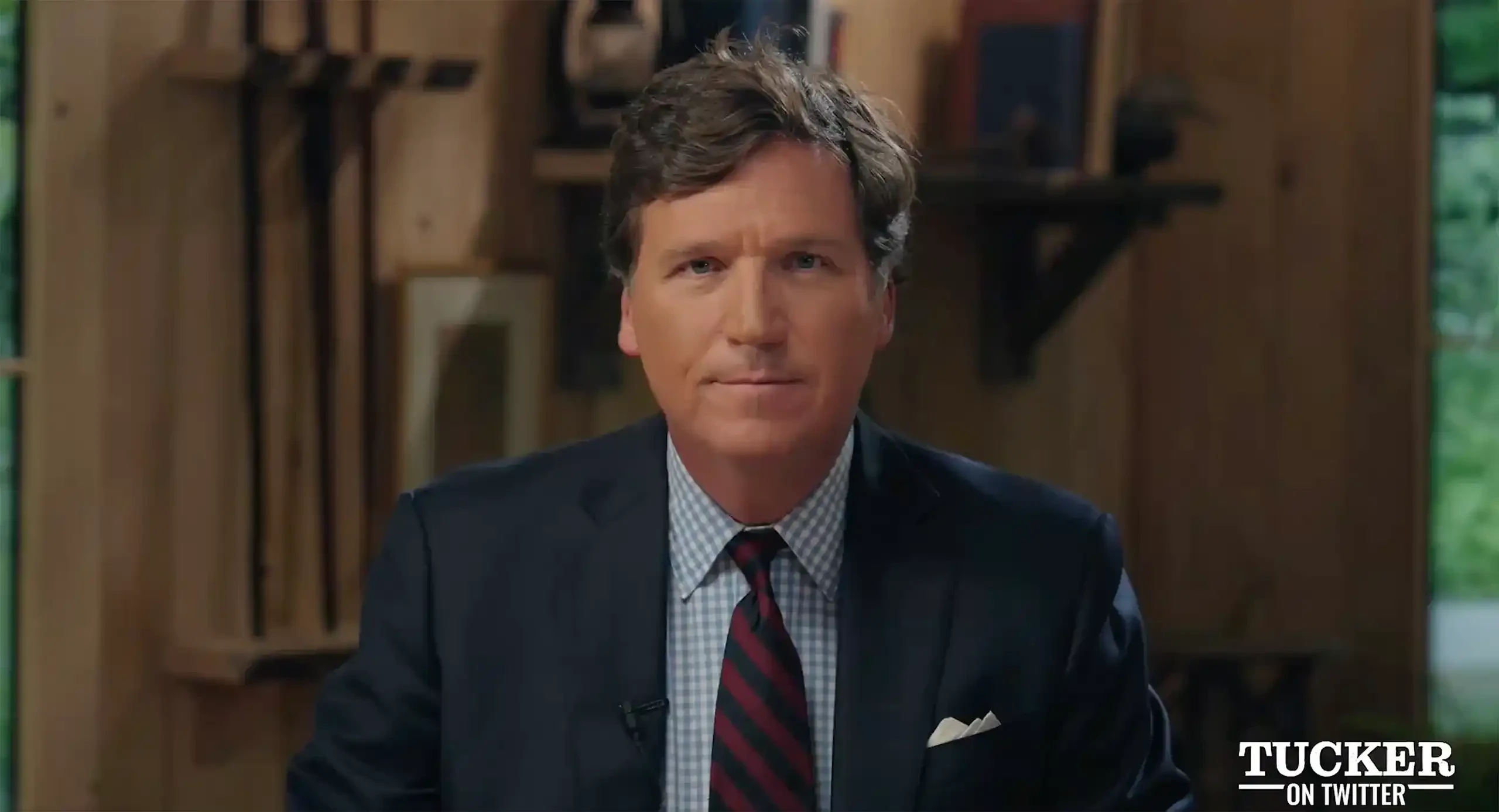
Tucker Carlson
He is a top-tier American political commentator. His former show, *Tucker Carlson Tonight*, long held the number one spot in ratings for American political programs and was the most important discursive platform for the conservative camp.
More importantly, he was also one of the most important media allies of the MAGA movement. Trump considered him “one of us.” During the 2024 election campaign, the two appeared together on stage multiple times. Carlson was essentially the loudest megaphone for the MAGA movement in the media landscape.
But after the U.S.-Israel joint military strike on Iran in February, everything changed.
Carlson publicly condemned the war, calling the joint strike “disgusting, profoundly evil,” and explicitly stated, “This is Israel’s war, not America’s war.” Trump promptly kicked him out of MAGA: “Tucker has lost his way, he is not MAGA. MAGA is about making America great again, MAGA is America First, and Tucker is none of those things.”
Since then, Carlson has publicly claimed that the CIA is preparing to indict him on charges of being an “unregistered foreign agent,” simply because he had text message contact with Iranian parties before the war broke out.
This war has thus evolved into a rift within the MAGA camp and the establishment: The establishment seeks to reverse decline through war, while some, represented by Carlson, believe this is digging their own grave. Trump kicking Carlson out of MAGA is a microcosm of this internal rupture.
Carlson’s current predicament is deeply ironic: He had predicted countless times on his show that the “deep state” would use legal means to target dissenters. But now he himself has become the dissenter.
At this critical juncture, he invited Jiang Xueqin—a Beijing high school teacher who predicted two years ago that America would lose this war—to sit before his camera.
The Three Predictions That Made Him Famous
In May 2024, when Biden was still leading the White House, Trump hadn’t even survived the two assassination attempts that summer, and the election outcome was far from clear. In what seemed like an ordinary class, Jiang Xueqin made three predictions to his students:
1. Trump will win the election in November.
2. The U.S. will get involved in a war with Iran.
3. The U.S. will lose this war, and it will forever change the global order.
Looking back now, the first two predictions have come true:
On November 5, 2024, Trump defeated opponent Kamala Harris in the U.S. election.
On February 28, 2026, the U.S. and Israel jointly launched a military strike on Iran.

Screenshot from the “Predictive History” video
The third prediction is still unfolding.
These classroom contents were posted on his YouTube channel, “Predictive History.” No subtitles, no editing, just a neatly dressed Teacher Jiang and a blackboard. According to him, the channel’s inspiration came from the concept of “psychohistory” in the works of science fiction writer Isaac Asimov: the belief that history has structural laws, and through mathematical models and group psychology analysis, future trajectories can be deduced.
After the U.S.-Iran war broke out, this old video from 2024 went viral across the internet, with comment sections filled with American astonishment. This made Jiang Xueqin famous overnight. The video’s daily views exceeded 4 million, and his channel’s accumulated subscriptions surged past 2 million.
Will the U.S. Lose This Middle East War?
In 415 BC, Athens, immersed in the illusion of its imperial peak, rashly saw Sicily as a soft target. They dispatched the most magnificent expeditionary fleet in history, only to bury an entire generation of its finest young men and almost all its wealth in that distant land due to severed supply lines and the collapse of support at home.
This is Jiang Xueqin’s historical analogy for America’s potential fate after “getting involved with Iran.”
His core argument is that the U.S. military is essentially a Cold War-era “muscle-flexing” system—expensive, pursuing technological deterrence rather than resilience for a protracted war of attrition. This mismatch manifests in reality as an absurd asymmetry, such as using interceptor missiles worth millions of dollars to counter drones costing $50,000.
After the war began, Jiang Xueqin still believed Iran held the advantage. In a March 3 interview with the American independent news and political commentary program *Breaking Points*, he pointed out that Iran holds a sinister trump card: paralyzing the entire petrodollar system within weeks by attacking seawater desalination facilities in the Gulf region.
Kuwait gets 90% of its drinking water from desalination, Saudi Arabia 70%. Systematic destruction of these facilities would deepen regional instability and further trigger humanitarian disasters and migration crises in the Gulf.

Jiang Xueqin on Breaking Points
And just five days after the program aired, on March 8, Iran attacked a desalination plant in Bahrain.
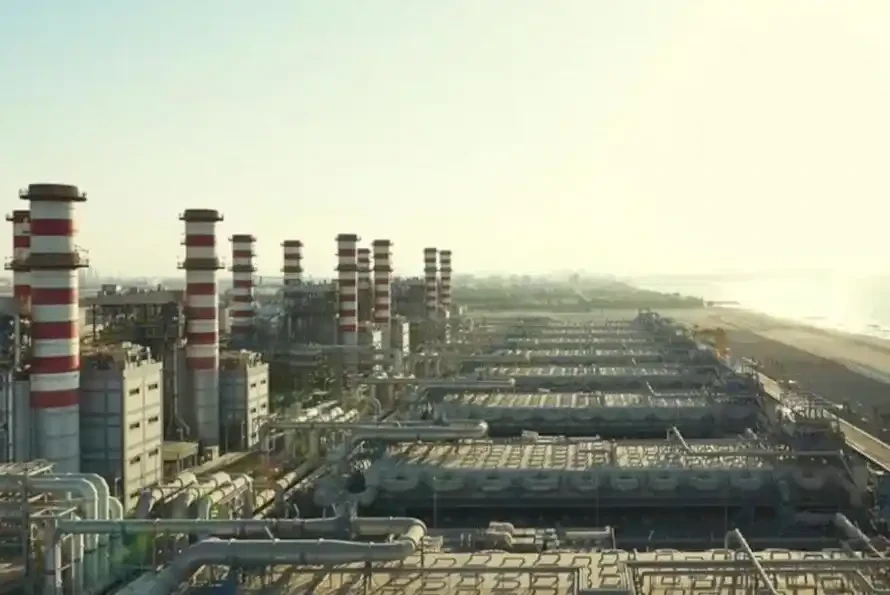
Desalination plants in the Middle East
On Tucker Carlson’s show, Jiang Xueqin’s predictions looked further ahead and were more unsettling:
The modern global economy is built on a premise: energy is cheap and readily available. That premise is now unraveling.

Tucker Carlson in conversation with Jiang Xueqin
Jiang Xueqin believes the Iran war will be highly similar to the Ukraine war: it will drag on, becoming a war of attrition. America cannot withdraw because, once it does, the only regional power capable of filling the security vacuum would be Iran. With about one-fifth of the world’s oil passing through the Strait of Hormuz daily, if Gulf countries tilt towards Iran, the petrodollar system would collapse.
His expression was very direct: “The U.S. economy today is essentially a Ponzi scheme, kept running by foreigners continuously buying dollars.” The U.S. currently carries nearly $39 trillion in debt, having relied for decades on oil-producing countries settling oil in dollars and then recycling that money back into the U.S. economy. Once this cycle is interrupted, the consequences would be devastating.
Based on this judgment, he outlined three major trends he believes will arrive regardless of who wins or loses: deindustrialization driven by expensive energy, nations being forced to rearm, and the return of mercantilism after the collapse of global supply chains.
He also predicted that, to maintain the front lines, Trump would very likely order a national draft, which would trigger street riots, followed by the deployment of the National Guard. “So, unfortunately, America will likely experience years of factional violence,” he said on the program.
Under this logic, this year’s Oscar-winning film *Fight Again* might no longer be a cinematic hypothesis, but the final rehearsal before a systemic collapse.
The Foundation of His Predictions
Jiang Xueqin’s life trajectory is itself a history of boundary-crossing practice. At age 6, he immigrated to Canada with his family and grew up in Toronto. On a scholarship, he entered Yale University, majoring in English Literature. After graduation, he returned to China. For nearly two decades since, he has worked as a journalist, documentary filmmaker, UN project officer, while deeply engaging in China’s education reform practices.
In 2022, he returned to Beijing and joined Moon School. Its founder, Wang Xiqiao, born in the mid-1990s, is himself an active educational innovator.
Moon School’s educational logic aligns intrinsically with the direction Jiang Xueqin has cultivated for twenty years: abandoning subject-based scores to evaluate students, emphasizing solving problems in the real world.

Jiang Xueqin on the Moon School website
Here, Jiang Xueqin teaches a year-long Western philosophy course, guiding students through readings like *The Epic of Gilgamesh*, Plato’s *Republic*, and Descartes’ *Meditations*. But what he truly wants to teach his students is: to critically and objectively examine themselves and the world from a higher vantage point.
This is precisely the underlying capability he relied on to make those three predictions—not the accumulation of knowledge in a specific professional field, but a way of thinking that penetrates surface appearances to identify structural patterns.
Those Who Grasp Patterns Are Scarce in Any Era
Jiang Xueqin once said in class that a correct historical framework should simultaneously do three things: connect the past, explain the present, and predict the future. Only by achieving all three can one possibly approach the truth.
The flames at the desalination plants, the cracks in the petrodollar system—these are inevitable manifestations of structural forces reaching certain inflection points. The “psychohistory” in Asimov’s works is captivating precisely because it believes that beneath the chaotic surface, history has its own grammar. His three predictions are one self-verification of this framework in reality.
But the framework itself does not provide answers. This is probably also why Jiang Xueqin chooses to remain in the classroom—not because it is safe enough, but because there are still people there willing to ask questions seriously.
本文来源于互联网: Jiang Xueqin: A Viral Beijing High School Teacher Who Predicted America’s Defeat in Advance
Related: Arthur Hayes: Middle East Flares Up, Time to Be Bullish on Bitcoin
Original Author: Arthur Hayes Original Compilation: Peggy, BlockBeats Editor’s Note: From the Gulf War to the Global War on Terror, and then to the Afghanistan “Surge,” U.S. military operations in the Middle East have almost 定义ned the international political cycle of the past few decades. Accompanying these wars are not only geopolitical conflicts and massive fiscal expenditures but also a frequently overlooked variable: monetary policy. This article reviews several key war inflection points since 1990, tracing the subtle relationship between war, fiscal pressure, and Federal Reserve policy: following multiple Middle East conflicts, the Fed has often responded by cutting interest rates or implementing easing policies to stabilize the economy and financial markets. Based on this, Arthur Hayes (co-founder of BitMEX) offers a market-oriented observation: when geopolitical conflicts escalate and fiscal…























 简体中文
简体中文  English
  繁體中文
繁體中文  日本語
日本語  Tiếng Việt
  العربية
  한국어
한국어  Bahasa Indonesia
  हिन्दी
  اردو
اردو  Русский