







Vitalik’s “Sanctuary Technology” Manifesto: How Ethereum Writes Censorship Resistance into the Protocol?
These questions may sound like extreme hypotheticals, but they are increasingly becoming realistic reference points for Ethereum’s protocol design.
In early March, Vitalik Buterin introduced a new formulation, explicitly stating that the Ethereum community should understand itself as part of the “sanctuary technologies” ecosystem: these free, open-source technologies enable people to live, work, communicate, manage risk, accumulate wealth, and collaborate towards common goals, while maximizing their ability to withstand external pressure.

This formulation may seem like an abstract upgrade in values, but when viewed in the context of Ethereum’s recent protocol evolution, it actually corresponds to very specific engineering problems:
As block building becomes increasingly specialized, transaction ordering rights become more centralized, and public mempools become more vulnerable to sandwich attacks and front-running, how can Ethereum continue to uphold the most fundamental bottom line of an “open network”—users’ transactions should not be easily blocked by a minority.
1. Vitalik Coins a New Term: “Sanctuary Technologies”
Vitalik’s starting point this time carries a rare candor.
He did not continue using grand, “change the world” rhetoric. Instead, he acknowledged that to this day, Ethereum’s improvement to the practical lives of ordinary people remains limited. For instance, while on-chain financial efficiency may have improved and the application ecosystem has become richer, many achievements still remain within the internal cycles of the کرپٹو دنیا
Therefore, he proposed a new way of positioning: rather than understanding Ethereum as merely a financial network, it’s better to see it as part of a broader “sanctuary technologies” ecosystem.
According to his definition, such technologies typically share several common characteristics: They are open-source and free, usable and replicable by anyone; they help people communicate, collaborate, manage risk and wealth; more importantly, they can continue to operate in the face of government pressure, corporate blockades, or other external interventions.
Vitalik even offered a vivid analogy—a truly decentralized protocol should be more like a hammer than a subscription service. You buy the hammer, it’s yours; it won’t suddenly fail because the manufacturer goes out of business, nor will it one day pop up a notification telling you “this feature is unavailable in your region.”
Ultimately, if a technology is to serve a sanctuary function, it cannot rely on the continued existence of a centralized organization, nor can it keep users perpetually in a passive position of receiving services.

Image Source: CoinDesk
This inevitably brings to mind another standard Vitalik has often mentioned for testing Ethereum’s long-term value: the walkaway test. This test asks a very simple question: if all of Ethereum’s core developers collectively disappeared tomorrow, could the protocol still function normally?
This is not a slogan, but an extremely strict standard for decentralization, because what it truly interrogates is not “whether there is a decentralization narrative now,” but “whether this system can still stand in the worst possible future.”
Applying this question to the block production level yields a very concrete answer: For a chain to pass the walkaway test, it cannot allow transaction inclusion rights to be held long-term by a minority, nor can it allow public transaction flows to be inherently exposed to risks of front-running, sandwich attacks, and censorship.
This is precisely the backdrop against which FOCIL and encrypted mempools have entered Ethereum’s core discussions.
2. Censorship Resistance Returns to Protocol Center Stage: FOCIL + Encrypted Mempool
We need to properly unpack the problems currently faced by Ethereum’s public mempool.
Over the past few years, Ethereum’s block building has continuously moved towards specialization. To improve efficiency and MEV extraction capabilities, the role of builders has become increasingly important. Block production is no longer the idealized state where every validator independently builds blocks locally. While this has real benefits, the cost is clear:
Once block building rights concentrate towards a few powerful participants, censorship is no longer just a theoretical risk. Theoretically, any major builder could choose to refuse to include certain transactions, such as transfers from sanctioned Tornado Cash addresses.
In other words, the problem Ethereum faces today is no longer just about high transaction fees or insufficient throughput, but whether public transaction infrastructure remains trustworthy for ordinary users.
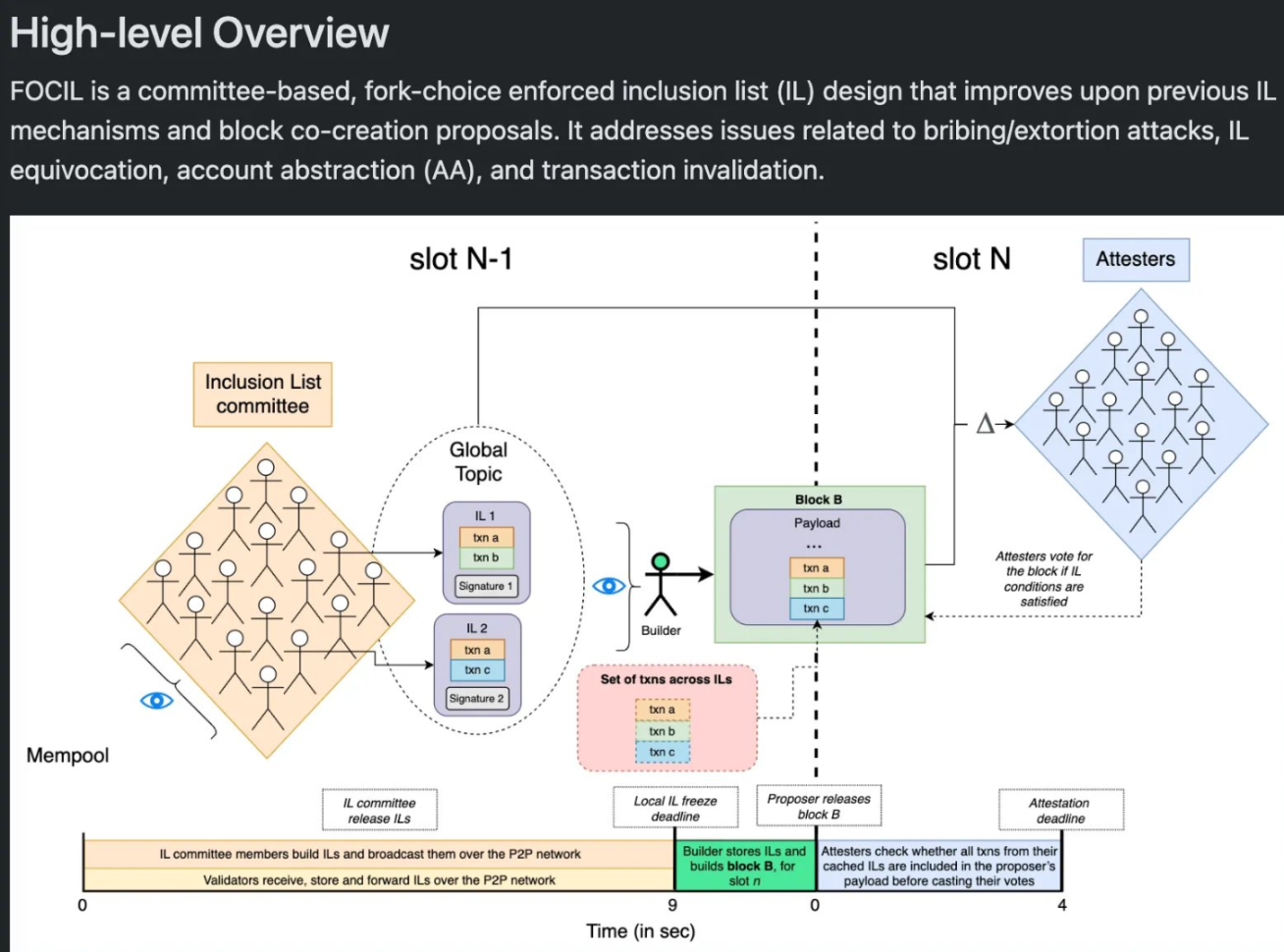
Therefore, FOCIL (Fork-Choice Enforced Inclusion Lists) is the protocol layer’s direct response to the censorship problem. Its core idea is not complicated: by introducing an Inclusion List mechanism, whether a transaction can be included in a block in a timely manner no longer depends entirely on the unilateral will of the proposer or builder.
In this mechanism, an Inclusion List Committee is selected from the validator set for each slot. Committee members form a list of pending transactions based on the mempool they observe and broadcast it; the proposer of the next slot needs to build a block that satisfies the constraints of these lists, and attesters will only vote for blocks that meet the conditions.
In other words, FOCIL does not eliminate builders, but provides stronger inclusion guarantees for valid transactions in the public mempool through fork-choice rules. This means builders can still optimize ordering, still improve efficiency and profits around MEV, but they no longer hold the power to decide whether a legitimate transaction is eligible to enter a block.
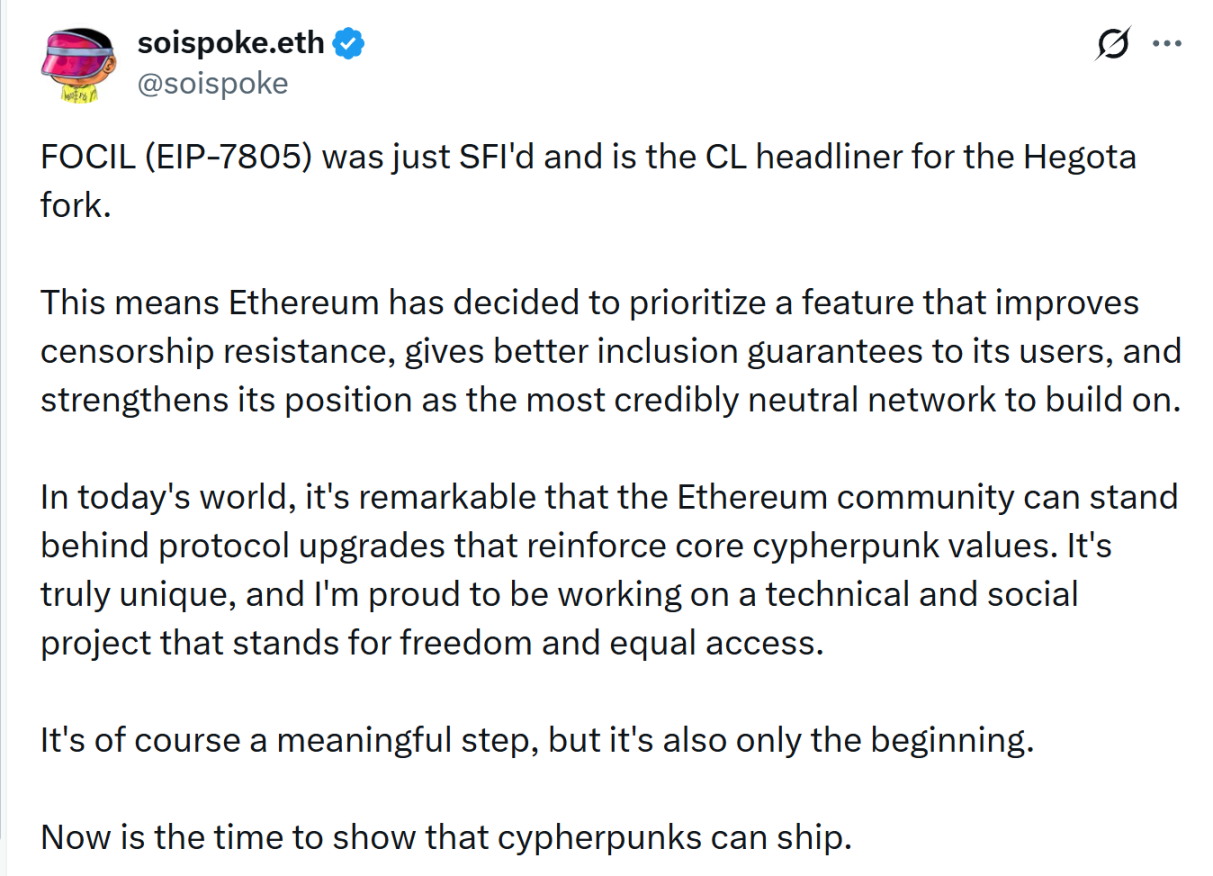
Although controversial, FOCIL has been confirmed as a core consensus layer proposal (Specification Freeze Included status) for the next major upgrade, Hegotá, expected to launch after the Glamsterdam upgrade in the second half of 2026.
However, FOCIL does not solve another equally critical problem: before a transaction is actually included in a block, has it already been seen by the entire market, allowing MEV Searchers to front-run, sandwich, or reorder it, especially targeting DeFi transactions? For ordinary users, this means that even if not censored, they might still be specifically harvested before their transaction enters a block.
This is the root of sandwich attacks.
The main solutions currently under community discussion are LUCID (proposed by Ethereum Foundation researchers Anders Elowsson, Julian Ma, and Justin Florentine) and EIP-8105 (Universal Enshrined Encrypted Mempool). The EIP-8105 team recently announced full support for LUCID, and both teams are collaborating.
The core idea of an encrypted mempool is:
- When a user sends a transaction, its content is encrypted;
- The transaction is only decrypted after being packed into a block and reaching a certain confirmation level;
- Before that, searchers cannot see the transaction intent, preventing sandwich attacks or front-running;
- The public mempool thus becomes “safe to use” again;
As the researchers stated, ePBS (execution-layer proposer-builder separation) + FOCIL + encrypted mempool together form the “Holy Trinity of Censorship Resistance”—a complete solution providing systemic defense across the entire transaction supply chain.
Currently, FOCIL has been confirmed for Hegotá; the encrypted mempool solution (LUCID) is actively vying to be included as another headline proposal for Hegotá.
3. What Does All This Mean
Zooming out, FOCIL and encrypted mempools are not just new terms on another round of Ethereum’s technical upgrade list. They are more like a signal:
Ethereum is putting “censorship resistance” back at the center of protocol design.
After all, while the blockchain industry often talks about “decentralization,” when a transaction is truly censored, intercepted, or disappears from the network one day, most users realize that decentralization is never the default state—it’s something that must be fought for with protocol code.
As early as February 20th, Vitalik posted that the FOCIL mechanism has important synergistic effects with Ethereum’s account abstraction proposal EIP-8141 (based on 7701). EIP-8141 elevates smart accounts (including multisig, quantum-resistant signatures, key changes, gas sponsorship, etc.) to “first-class citizens,” meaning operations from such accounts can be directly packaged as on-chain transactions without additional wrapping.
Some might question: FOCIL adds protocol complexity, encrypted mempools might bring efficiency losses—are these costs worth it?
This is precisely where “sanctuary technologies” are most noteworthy. The truly unique value of blockchain may never be just about putting assets on-chain or speeding up transactions, but whether it can continue to provide people with a permissionless, hard-to-shut-down, hard-to-deprive digital outlet under high-pressure environments.
From this perspective, the significance of FOCIL and encrypted mempools becomes clear: they aim to transform things that originally relied on goodwill, market self-balancing, and “hoping nothing goes wrong” into more robust protocol rules.
When countless users can freely live, work, communicate, manage risk, and accumulate wealth on this “digital stable island” without fear of being expelled or censored by any centralized entity—that is when Ethereum truly passes the “Walkaway Test.”
And that is the ultimate meaning of sanctuary technologies.
یہ مضمون انٹرنیٹ سے لیا گیا ہے: Vitalik’s “Sanctuary Technology” Manifesto: How Ethereum Writes Censorship Resistance into the Protocol?
Compared to Nvidia, which is dancing at the center of the AI stage, Intel (INTC.M) seems more like it has one foot lingering at the ICU door. With the “technology evangelist” Pat Gelsinger stepping down at the end of last year, the new captain, Lip-Bu Tan, has officially taken over this old, heavily burdened machine. The latest Q4 earnings report once again raises a familiar question: Has this century-old chip giant reached its end? If you only look at the stock price performance after the earnings release, the answer might be disheartening. But if you extend the timeline, what Intel is experiencing might not be a final flicker of life, but a critical moment of pulling the oxygen tube in the ICU and attempting to breathe on its own. Objectively…
相关文章






























 اردو
اردو  English
  繁體中文
繁體中文  简体中文
简体中文  日本語
日本語  Tiếng Việt
  العربية
  한국어
한국어  Bahasa Indonesia
  हिन्दी
  Русский