







Author|Azuma (@azuma_eth)

The Vault model in DeFi is likely familiar to everyone by now.
In the simplest terms, the Vault model works like this: everyone pools their money into a fund, which is then managed by a so-called professional team (usually called a Curator). The Curator employs various complex and dynamic strategies to generate higher returns, and finally, everyone shares the profits — the users who provided the capital take the lion’s share of the returns, while the Curator earns a management fee or performance fee.
But have you heard of a Vault focused on prediction markets?
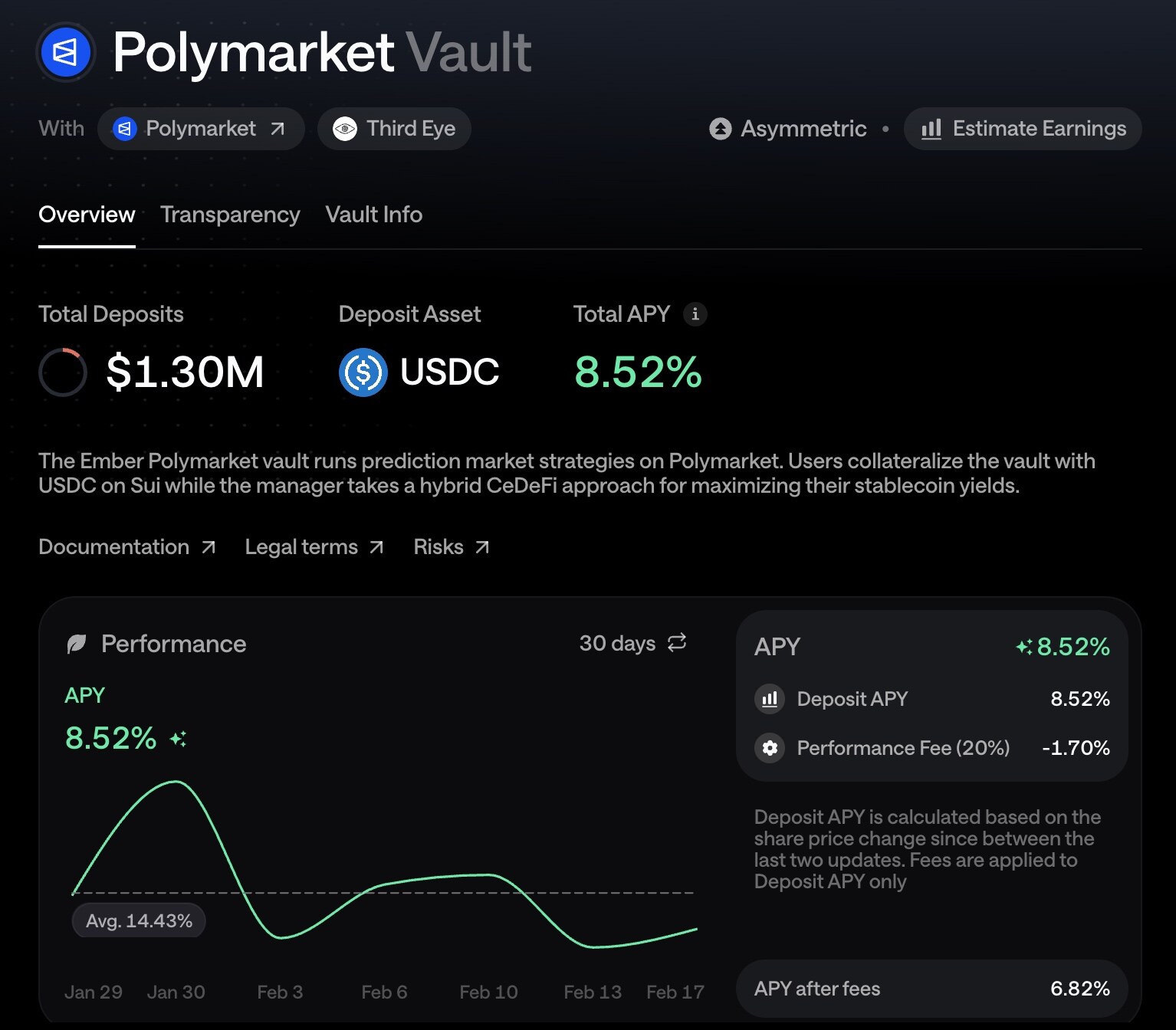
On January 19th, Ember Protocol, a Vault management protocol on Sui, officially announced the launch of a new Vault product called Polymarket Vault. This Vault is managed by the liquidity fund Third Eye, which is responsible for executing strategies on Polymarket to generate returns. Users can deposit USDC into this Vault and share in the profits.
The official Ember Protocol page shows that this Vault has already absorbed $1.3 million in deposits, with a current real-time annualized yield of 8.52% (6.82% after deducting a 20% performance fee).

Odaily Note: The Vault details page shows a performance fee of 20% and a redemption period of 14 days.
In terms of profit-sharing and risk structure (risk structure is the key point, to be discussed in detail later), the operational logic of Polymarket Vault is no different from common DeFi Vaults. The core distinction lies in the fact that the manager, Third Eye, has shifted its primary “money-making” arena from the relatively mature DeFi market to the earlier-stage prediction market.
Earlier-stage markets often imply greater potential for sophisticated players to capture extra returns. In this regard, if the manager can effectively leverage professional advantages (such as using high-frequency dynamic market-making to capture maker subsidies or building more precise data models around sports markets), prediction market Vaults theoretically have a certain market space. However, after examining the practical strategies of Polymarket Vault, it’s hard not to worry about the potential risks involved.
According to Polymarket Vault’s disclosure, the operational account name for this Vault on Polymarket is third-eye (https://polymarket.com/@third-eye). We attempted to uncover this account’s transaction history and used AI tools like Deepseek to analyze its trading patterns.
On-chain records show that the account’s main bets on Polymarket are concentrated in the political sphere, particularly on hot events related to the Federal Reserve. Operationally, it tends to favor the “sweeping the tail” strategy often mentioned in the community — focusing on highly certain events and using relatively small risk (which also means higher cost) to capture the last bit of profit from specific events.

Regarding the viability of the “sweeping the tail” strategy itself, community opinions remain divided. Some see it as a stable income play, while others believe it’s only a matter of time before a major loss occurs (one big loss wiping out hundreds of gains). This is precisely the issue Third Eye faces. If the institution could properly control the position size of each bet, the problem wouldn’t be so glaring (even if there’s a drawdown, its impact on the overall fund would be limited). However, the current situation is exactly the opposite — Third Eye’s positions are too concentrated, tying both risk and return to the outcome of a single event.
More specifically, Third Eye has bet nearly $1.187 million (currently showing a floating loss of $13,000) at an average price of $0.95 on the event “Will Trump nominate Kevin Warsh as the next Fed Chair?” and has not hedged by betting on other candidates. This accounts for over 90% of the $1.3 million raised by the Vault, essentially an all-in bet.
Although Trump has previously stated he would nominate Kevin Warsh to lead the Fed, this still requires formal confirmation by the U.S. Senate to take effect. Objectively, this process faces resistance from both Democrats and Republicans (some senators believe the investigation into Powell should conclude first). This is why the probability of this event remains around 95% even after Trump’s statement.
If you were trading on Polymarket yourself, I would agree this is a reasonable bet, as Kevin Warsh’s appointment is still the most likely outcome. But Third Eye’s situation is completely different; it is using funds deposited by users into Polymarket Vault. Once an unexpected situation occurs, what do you think the result will be?

Regarding the strategy execution risk of the manager, Ember Protocol describes it as follows: “Execution risk arises from the manager’s potential inability to effectively implement its strategy or deploy collateral as intended. This can be caused by various factors, such as delays in trade execution, network congestion, or technical failures of the DeFi protocol itself. Furthermore, poor timing or trade execution errors may lead to returns falling short of expectations or direct economic losses. Although managers employ automated tools and operational safeguards to mitigate these risks, execution risk remains an inherent characteristic of decentralized markets and smart contract-based trading.”
So, the answer to the previous question is simple: if Third Eye’s bet on Kevin Warsh encounters an unexpected outcome, all Polymarket Vault depositors will share the loss. Forget about the 8.5% interest; preserving the principal would be a luxury.
Within DeFi Vaults, Curators’ disregard for risk control is also a widespread issue. This is driven by the Curator’s profit model and the market’s lack of effective supervision and accountability mechanisms — for details, refer to “What is the Role of a Curator in DeFi? Could It Be a Hidden Risk This Cycle?“
Compared to DeFi, prediction markets may face even more severe risk control pressure. The reason is that price changes in DeFi markets are often continuous. When a strategy fails, managers can still control drawdowns through hedging, stop-loss, or even liquidation. However, volatility in prediction markets is often driven by discrete real-world events, and price changes are often jumpy. When sudden changes occur, it is difficult for managers to control the magnitude of the drawdown.
Imagine a simple scenario: if at some moment, news suddenly breaks that Kevin Warsh cannot serve as the next Fed Chair (regardless of the reason — Senate obstruction, Trump changing his mind, or a personal accident), the price of YES shares for that event would instantly plummet from $0.95 to near zero. It would be very difficult to do anything during this process to reduce losses — even if you sell at a discount, no one would take the other side.
Given the non-zero probability of this hypothetical scenario, it is difficult to endorse Third Eye’s risk control quality and strategy rationality. Let’s ask the simplest question: knowing the source of its profits, would you dare to deposit funds for that 8.5% return?
یہ مضمون انٹرنیٹ سے لیا گیا ہے: An 8.5% APY Prediction Market Pool, with an All-In Strategy?
Related: Is Crypto Over? Don’t Give Up, Liquidity Relief is on the Way
Compiled by:CryptoLeo (@LeoAndCrypto) This morning, Raoul Pal, CEO of Real Vision and GMI (Raoul Pal’s investment bible), published an article titled “False Narratives….and Other Thoughts”. Through data comparison and macro analysis, he explained the recent downturn and crisis facing the crypto industry, stating that the industry winter will pass soon, and everyone needs to be patient and not lose faith in the industry. Odaily has translated it as follows: These are insights I derived while writing for GMI over the weekend, hoping to bring you some confidence. I would usually keep this content for discussions within GMI and Pro Macro, but I know you all need this to ease your tense nerves. Mainstream Narrative: Is Crypto Over? The mainstream view is that Bitcoin and cryptocurrencies have crashed, this cycle is…
相关文章































 اردو
اردو  English
  繁體中文
繁體中文  简体中文
简体中文  日本語
日本語  Tiếng Việt
  العربية
  한국어
한국어  Bahasa Indonesia
  हिन्दी
  Русский