








Core Insights
- The 암호화폐currency market in 2025 experienced intense narrative shifts, with market fatigue and skepticism accumulating throughout the year.
- The vast majority of narratives merely consumed short-term attention, but some narratives gave birth to real use cases and market structures, steadily driving industry evolution.
- Beyond trends centered on speculators, more narratives that are accessible to retail participants continuously emerged and expanded, broadening the market’s participation base. This is also a significant transformation.
1. Narratives, Narratives, and More Narratives
The most notable feature of the 2025 cryptocurrency market was the astonishing speed of narrative shifts. 시장 attention moved to the next hot topic before the current narrative was fully validated.
Meme coins drove particularly dramatic turns. New narratives emerged around Trump, Musk, and Sydney Sweeney. Investors’ gaze shifted with equal speed.
The core issue is that most narratives proved to be nothing more than one-time frenzies. They consumed short-term attention but failed to build foundational architectures that could evolve into real industries. Some market participants even fabricated false narratives to harvest investors. The result was increasing fatigue and deepening skepticism among market participants.
That said, not all narratives ended in exhaustion. Some established themselves as genuine industries, tangibly advancing the evolution of the cryptocurrency market. So, what persisted, and what vanished? This report will delve into the major narratives that shaped 2025 and extract lessons from their rise and fall.
2. What Insights Did the 2025 Narratives Reveal?

원천: Tiger Research
2.1. Retention Value Far Exceeds New User Acquisition
출처: Dune
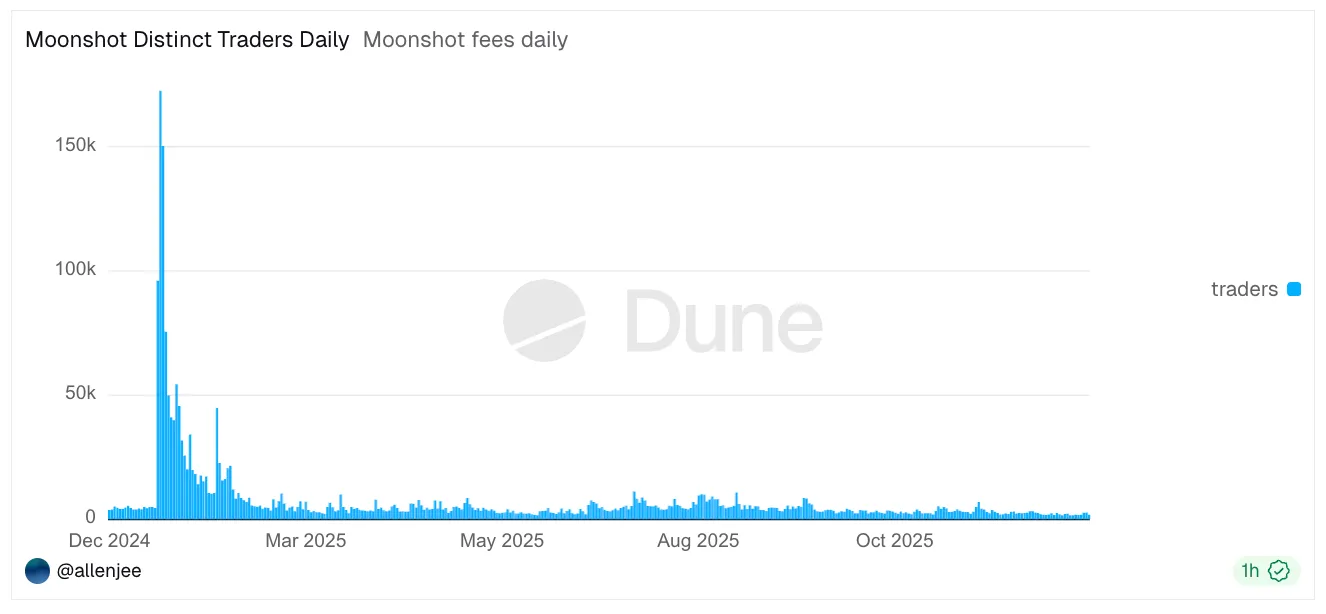
Meme coins captured the most market attention this year. Their simple and intuitive nature even attracted those who previously dismissed cryptocurrencies or found them too complex. Trading applications like Moonshot further lowered the entry barrier, leading to a surge of new users in a short time.
However, most users did not stay long. They came chasing quick profits and left just as swiftly. Their activities neither spread to other services nor generated any lasting spillover effects. The market saw massive inflows, but it only produced one-time engagement heat.
This case clearly shows that when the right catalyst meets low barriers to entry, large-scale user influx is indeed possible. Meme coins validated this potential. Simultaneously, they also revealed the reality that inflow alone is far from enough. If a project fails to design reasons for users to stay, inflows will eventually quickly turn into outflows. User retention remains the core challenge.
2.2. The Dual Nature of InfoFi
2025 was also the year InfoFi was taken seriously. InfoFi services flourished around platforms like Kaito, with users adopting a model of producing information and being incentivized for it. Combining incentive mechanisms with information production was a meaningful experiment that brought many retail participants into the market.
However, limitations soon emerged. Content quality is inherently subjective and difficult to measure quantitatively. Yet incentive distribution requires objective standards based on metrics, which gradually distorted participant behavior. Participants began prioritizing sensational content over information accuracy. As a result, platform X transformed from a space for information sedimentation into something closer to a billboard.
InfoFi demonstrated the potential to stimulate information production. But at the same time, it left an unresolved question: How do we evaluate and reward information quality? If this challenge cannot be solved, InfoFi may not expand the information ecosystem but instead exacerbate market fatigue.
2.3. Privacy Has Become a Necessity
출처: rwa.xyz
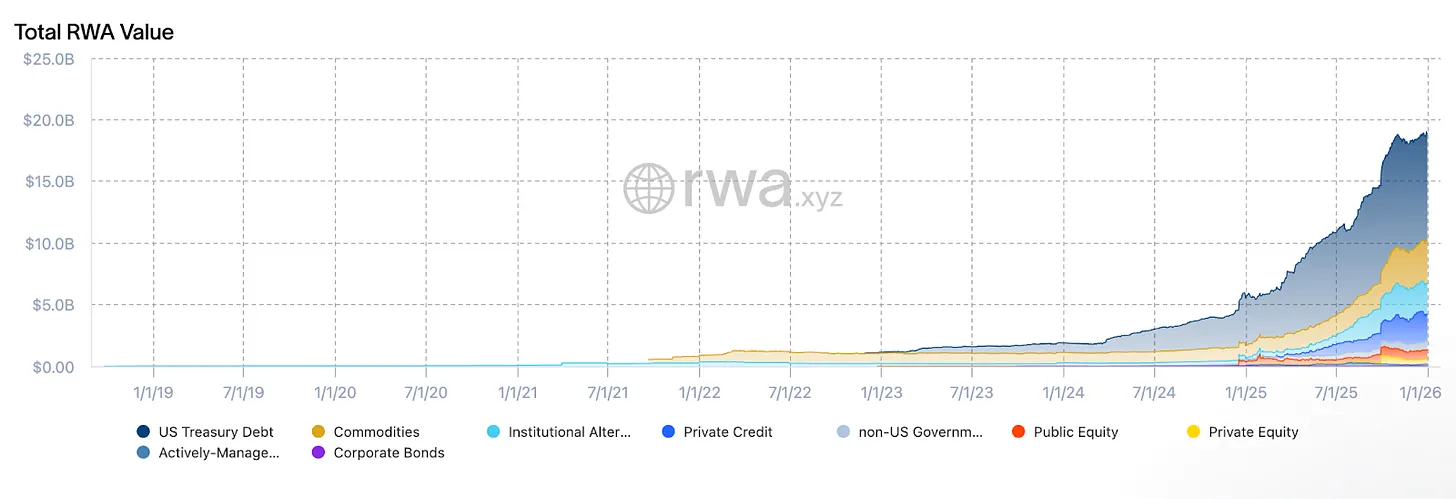
As institutional capital accelerates its entry, the cryptocurrency market is shifting from retail-led to institution-led. Alongside this shift, the privacy sector is gaining attention. This is no coincidence.

원천: Tiger Research
On-chain transparency has long been considered an advantage of cryptocurrency. However, an environment that exposes transaction size, timing, and holdings means complete exposure of strategies for institutional investors. The rising share of over-the-counter (OTC) trading in traditional finance also reflects growing unease with fully transparent structures.
Transparency does not benefit all participants equally. As discussions about institutional participation and market expansion continue to deepen, privacy can no longer be treated as a secondary issue.
2.4. The Year Cryptocurrency Demonstrated Product-Market Fit
2025 was the year cryptocurrency moved beyond abstract potential and began to show viable, real-world application scenarios. Stablecoins, x402, and prediction markets, each in their own form, share a core advantage: they organically combine cryptocurrency’s borderless monetary properties and its ability to provide transactional trust with solving real-world problems.
The key to these cases is that cryptocurrency can facilitate transactions and provide trust in outcomes without a central authority. In an environment where global participants engage simultaneously, cryptocurrency can execute transactions and verify results without intermediaries. Traditional systems struggle to offer such advantages. These cases show that in areas meeting specific conditions, cryptocurrency can demonstrate relative advantages.
These examples do not prove cryptocurrency is a panacea for all fields. But they indicate that when cryptocurrency’s unique attributes align with the problem structure, projects can achieve clear product-market fit. 2025 revealed these conditions more clearly for the first time.
3. The Rapid Narrative Cycle and What Settles
An unusually high number of narratives emerged in the 2025 cryptocurrency market. Before the current narrative was fully validated, attention shifted to the next story, with many narratives fading quickly after brief consumption. Given the astonishing speed of these shifts, the year could easily appear wasted on the surface.
However, dismissing 2025 as meaningless based solely on this impression is arbitrary. While narratives were short-lived, various experiments were simultaneously advancing behind the scenes, and institutions began seriously planning integration. The trends of this period moved beyond purely speculative narratives. Compared to niche stories centered on speculators, more narratives that retail participants could access relatively easily kept emerging. This began to broaden the market’s participation base.
Rapidly consumed narratives did not leave immediate results. However, this process helped clarify which architectures work and which are mere illusions. Now is the time to use these lessons as fuel to move to the next stage.
이 글은 인터넷에서 퍼왔습니다: Tiger Research: 2025, A Year of Narrative Frenzy
Related: Miners Amidst the Bitcoin Crash: Who’s Profiting? Who’s Holding On?
Original translation by Chopper The financial logic of Bitcoin miners is quite simple: they survive on fixed protocol revenue but face fluctuating real-world expenses. When markets are volatile, they are the first to feel the pressure on their balance sheets. Miners’ revenue comes from selling the Bitcoins they mine, while their operating costs are primarily the electricity bills for the heavy computers needed to run mining. This week, I tracked some key data for Bitcoin miners: the network pays them, the cost of earning that revenue, the remaining profit after deducting cash outlays, and the final net profit after accounting. With Bitcoin prices currently below $90,000, miners are facing difficulties. Over the past two months, miners’ average 7-day revenue has dropped 35% from $60 million to $40 million. Let me…




























 한국어
한국어  English
  繁體中文
繁體中文  简体中文
简体中文  日本語
日本語  Tiếng Việt
  العربية
  Bahasa Indonesia
  हिन्दी
  اردو
اردو  Русский