







$950 Million Short Positions, Two Perfectly Timed Trades: The Suspicion of Insider Trading in Oil Before Trump’s Ceasefire
The next day, as soon as the Asian market opened, crude oil prices dropped by about 15%, with WTI falling below $100. According to Reuters citing LSEG transaction data, the scale of this short position was “completely atypical for that time period.” Representative Ritchie Torres wrote to the U.S. Securities and تبادل Commission (SEC) and the Commodity Futures Trading Commission (CFTC) on April 8, requesting an investigation.
This was not the first time. More precisely, it was the second recorded instance of the same “playbook” since the current US-Iran conflict began.
The Same Trading Signature, Two Precise Hits
The one on the morning of Monday, March 22, 2026, was not as famous as the April 7 event because it did not trigger a sharp drop in oil prices. However, in terms of trade structure, it was the prototype of this “playbook.” According to transaction data cited by CBS News and the Financial Times, between 6:49 and 6:50 AM Eastern Time that day, which was 10:49 GMT, a total of 6,200 Brent and WTI futures contracts were traded within one minute, amounting to approximately $580 million.
Fifteen minutes later, Trump posted on Truth Social, stating that he was engaged in “constructive dialogue” with Iran and announcing a five-day delay in the plan to strike Iranian energy facilities. Crude oil prices plunged that day, the S&P 500 surged, and the Dow Jones Industrial Average gained over 1,000 points in a single day.

Aligning the timelines of these two events reveals a detail: the “Brent leg” within the 8,600 contracts on April 7 was also exactly 6,200 contracts. The same number appearing in two completely different time slots could be a coincidence or indicate the same position size. In trading circles, such repetition is called a “signature,” referring to a specific group of traders executing their fixed formula. CBS’s report cited two anonymous former CFTC investigators, stating that such precise repetition “is itself an investigative signal.”
9 Times the Norm, Occurring in the Hour No One Watches
Many readers who first saw this news thought 19:45 GMT was an “after-hours period.” Actually, it is not. Brent crude oil futures trade almost 24 hours a day electronically, closing only briefly on weekends. 19:45 GMT is a more subtle point. The day’s “settlement window”—the two minutes used by the exchange to determine the official daily settlement price—had just ended moments before (19:28 to 19:30 London time).
Once the settlement window ends, most European professional traders leave work. Trading desks in Tokyo and Singapore only come online several hours later. This hour is typically one of the most illiquid windows of the entire day. According to ICE’s official product specification documents, the real trading peak for Brent is concentrated during the European daytime hours.
Zooming in on the anomaly of that minute on March 22 provides a clearer contrast. According to LSEG transaction details cited by CBS, the normal volume for the same minute over the preceding and following five days was about 700 contracts. That minute saw 6,200 contracts traded, roughly 9 times the usual volume. The long blue bar in the chart represents that minute. The other gray bars before and after represent other minutes in the same hour, densely packed near the bottom.
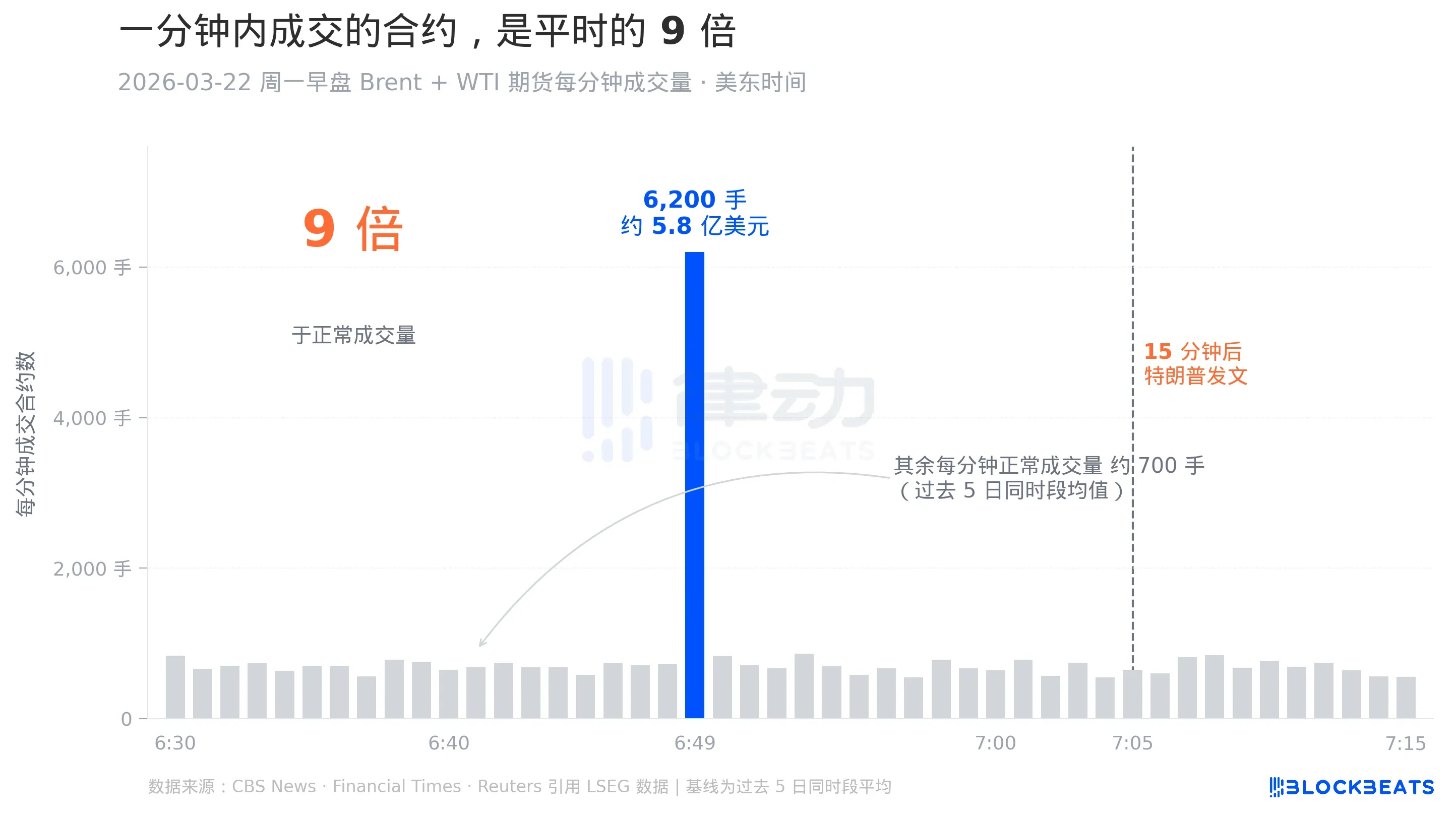
The significance of this contrast is that the 9-fold surge did not occur during the most liquid daytime hours but was concentrated in the thinnest minute of the order book. Paul Krugman, writing about this on his Substack, used an analogy, saying it was like “driving a truck and honking on an empty street late at night”—either not caring about being heard or having a compelling reason to act precisely at that time.
Three Trades in the Same Direction
This chart shows the other half of the anomaly on March 22 that many reports overlooked. Follow-up articles by the Financial Times and Peak Oil in late March mentioned that, during the same period, besides the $580 million crude oil short, two other positions were established in the same direction: one was a purchase of approximately $1.5 billion in S&P 500 E-mini futures, and the other was an independent $192 million short position on WTI (CL contract).
“S&P 500 E-mini futures” are the most active U.S. stock index futures contract on the exchange, with one contract representing about $250,000 in S&P 500 index value. It is a standard tool for institutions to hedge overall U.S. stock market direction. “Buying E-mini” is equivalent to betting on a rise in U.S. stocks. The “WTI separate short” is an additional bet on the downside on another crude oil futures product line (U.S.-traded WTI). Combined, these three positions amount to approximately $2.28 billion in notional value.

Looking at these three orders separately, they resemble a perfectly aligned paired trade, betting on the same macro scenario: a de-escalation of U.S.-Iran tensions. How would de-escalation affect the market? Oil supply fears subside, oil prices fall. Geopolitical risk premium disappears, stocks rebound. Piecing these three positions together forms the cleanest profit-making combination for this scenario. In Paul Krugman’s words, roughly, “If you knew you would see the words ‘constructive dialogue’ two hours later, these are the three trades you would place.”
The Same Playbook, Also Appearing in Prediction سوقس
Shifting perspective from the futures market to the تشفير world’s prediction market, Polymarket, reveals an almost identical mirror image.
Polymarket is a binary prediction contract platform built on Ethereum. Users bet on whether a specific event will occur, with odds determined by market participants themselves. Winners share the pool after the event outcome is confirmed. All its transactions are on-chain, and anyone can view each wallet’s history.
According to on-chain data cited by StockTwits, in the final week of the Polymarket contract “Will the US and Iran reach a ceasefire within 30 days?”, 8 accounts fit a “normal profile.” They were all public, established accounts, placing a total of about $70,000 in bets, with wins and losses, and the settlement process showed no suspicious points. However, simultaneously, 4 other accounts had a completely different profile. These 4 wallets were newly created just before the event, with no prior on-chain transaction history. Their first action after appearing was to heavily bet on “ceasefire will happen” at extremely low odds. They all won, collectively profiting over $600,000.

$70,000 versus $600,000—the multiple is 8.6 times. The latter’s profit is nearly nine times the total bet amount of the former. According to Polymarket’s own settlement rules, winner amount = bet amount × (1/odds). To earn $600,000 within a week, these 4 wallets either placed heavy bets at a time when the odds were extremely low (meaning the market strongly believed “no ceasefire”), or placed multiple dispersed bets. On-chain data indicates it was the former.
Ritchie Torres’s office mentioned this detail in their letter to the SEC and CFTC, listing it alongside the crude oil futures anomaly as evidence of “cross-market synchronous signals.” This is also why Torres had already pushed a legislative draft targeting insider trading in prediction markets, specifically regarding Polymarket, back in late March. For him, the crude oil futures side is not an isolated incident.
Will There Really Be an Investigation?
First, consider the reality at the federal level. According to the SEC’s enforcement report for fiscal year 2025 released in early April, the SEC initiated 313 new cases in the past year, the lowest point in the past decade, down 27% from 583 cases in fiscal year 2024. The CFTC has not released a comparable annual report simultaneously, but law firms Sullivan & Cromwell and Skadden, which track CFTC enforcement trends, noted in their early April commentary that the CFTC’s Division of Enforcement had noticeably slowed down in early 2025.
However, just about a week before Torres wrote his letter, the CFTC announced its top 5 enforcement priorities for 2026. According to Sullivan & Cromwell’s summary, the top priority is “insider trading, including in prediction markets,” and the second is “market manipulation, particularly in energy markets.”
The nuance here is that the CFTC has verbally elevated this matter to a top priority, but historically, the CFTC has rarely initiated cases based on “single anomalous trade” types in futures markets. Past successful energy commodity cases, such as the 2024 penalties against Trafigura, Freepoint, and TotalEnergies, were all long-term off-exchange manipulation schemes spanning 2 to 4 years, not targeting a single anomalous short position on the screen.
What could potentially yield results is another avenue. According to reports from OilPrice.com and Peak Oil, New York State Attorney General Letitia James has been using New York State’s Martin Act since April 2025 to track a series of “timely, high-return trades related to Trump’s public statements.”
The Martin Act is New York State’s securities anti-fraud law. It has a key feature federal laws lack: prosecutors do not need to prove the defendant had a subjective intent to defraud. They only need to prove that the trading behavior itself has objectively fraudulent characteristics to file a lawsuit. For events like “precise positioning,” subjective intent is precisely the hardest element to prove in federal insider trading cases.
هذا المقال مصدره من الانترنت: $950 Million Short Positions, Two Perfectly Timed Trades: The Suspicion of Insider Trading in Oil Before Trump’s Ceasefire
They launched an 8-week fellowship program—training not engineers or product managers, but storytellers and content creators. After the training, these individuals were directly assigned to a16z’s portfolio companies to help founders with product launches and content dissemination. The world’s top VC has started systematically teaching founders how to become KOLs. If you still think “building a personal brand/IP” is optional, this signal is worth reconsidering. The Customer Acquisition Math No Longer Works Let’s start with an uncomfortable number: Over the past 10 years, the customer acquisition cost (CAC) for to-C products has increased by 222%. In 2025, the cost per paid lead on Google Ads was **$70+**, and it’s still rising year-over-year. The median in the SaaS industry is even more outrageous—spending $2 to earn back $1 in annual revenue.…
相关文章































 العربية
  English
  繁體中文
繁體中文  简体中文
简体中文  日本語
日本語  Tiếng Việt
  한국어
한국어  Bahasa Indonesia
  हिन्दी
  اردو
اردو  Русский