







Interviewing 10 Dubai Workers: Some Were Asked to Sign a “Life-or-Death Waiver”
Author|jk

On February 28, 2026, the US and Israel jointly launched a military strike against Iran, which was immediately met with a large-scale counterattack from Iran. The skies over the Middle East were instantly torn by missiles. What was shattered was not just military installations on the battlefield, but also the lives of تشفير practitioners who had just settled in this land. Dubai, the city hailed in recent years as the “Promised Land for Web3,” now faces a severe test of a much more tangible nature.
To this end, Odaily interviewed several تشفير industry professionals based in Dubai, inquiring about their experiences, current situations, and their plans for the next safe haven.
Current Situation in Dubai: Airport Attacked, Hotel on Fire, Financial and Real Estate سوقs Show Delayed Reaction Signals
For those living in the UAE, Dubai has, in a sense, become a battlefield.
Since Iran initiated its “True Promise” retaliatory operation, Iran has launched over two thousand missiles and drones towards Dubai. A tug-of-war between missiles and anti-missile systems has unfolded in Dubai’s skies.
On the ground, Dubai International Airport and the Burj Al Arab hotel have already been affected. On Xiaohongshu, there are numerous scenes of the airport terminal being pierced by drone debris, smoke billowing, and passengers fleeing in all directions.
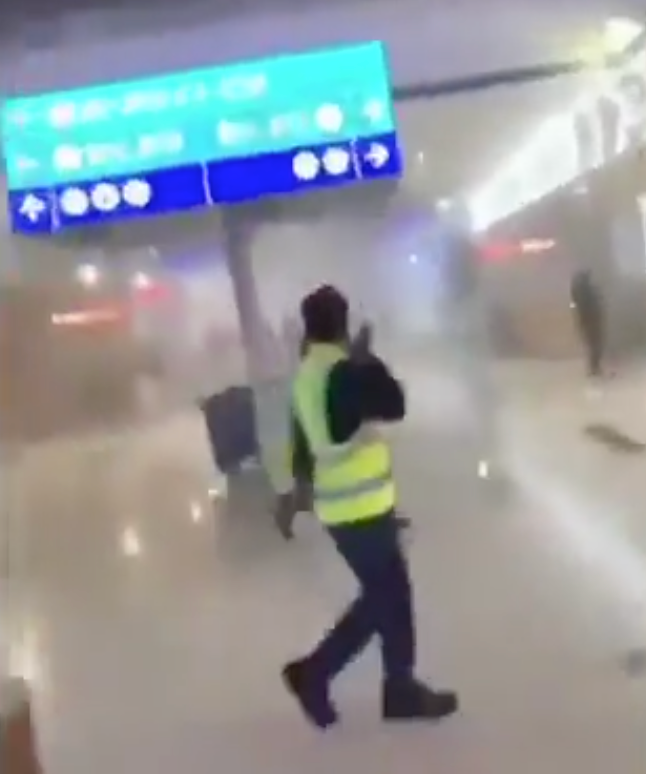
Emergency evacuation at Dubai International Airport when it was hit. Source: X

Area near the fuel depot at Dubai International Airport hit. Source: BBC
In local Chinese community groups in Dubai, people share daily updates like “I heard explosions again near my place.”
سابقًا، Odaily reported that the Fairmont The Palm hotel on the luxurious Palm Jumeirah island caught fire due to falling drone debris, injuring 4 people. (I checked this hotel; the cheapest room in the off-season costs around 1,500 RMB per night, and can reach three to four thousand during peak season.)
If you only follow the news, you might think nowhere in Dubai is safe.
An outsider’s first reaction might be: if the situation is this severe, has Dubai’s once-booming real estate market plummeted to the core? Should we all be evacuating?
What about the Real Estate and Financial سوقs?
When the retaliatory actions began, the Dubai Financial Market Real Estate Index (DFMREI) plummeted from around 16,000 points to the 11,500-11,700 range, a drop of approximately 30% in just a few weeks. Residential transaction volume also fell by 25%-30%. The DFMREI dropped from around 16,140 points on February 28 to around 11,500 points in mid-March, a decline of about 30%, hitting its lowest point since April 2025 and erasing all gains accumulated in 2026. As of March 31, the DFMREI closed at 11,721.04 points, basically consolidating at low levels with no significant rebound yet.
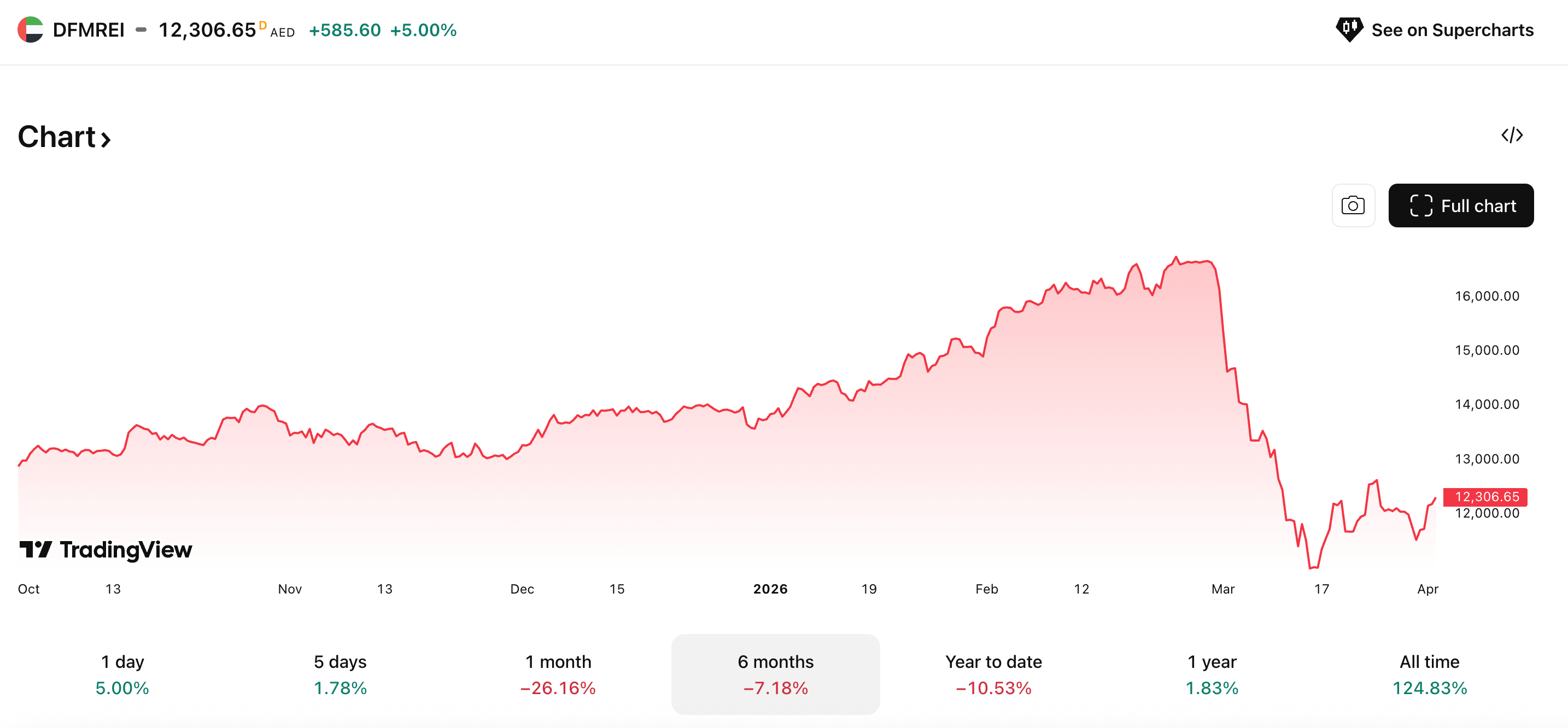
Dubai Financial Market Real Estate Index. Source: TradingView
However, it’s important to note that the DFMREI tracks the stock prices of real estate companies listed on the Dubai exchange (such as Emaar, DAMAC, etc.), not actual property transaction prices. A 30% drop in the index does not mean Dubai apartment prices fell 30%. In terms of actual transactions, according to local news reports, from February 28 to March 22, actual property transactions decreased significantly compared to the same period in previous years, with average transaction prices falling by about 4%-5%.
Regarding financial markets, as of March 31, the Dubai and Abu Dhabi stock markets have lost approximately $120 billion in market capitalization since the conflict began on February 28. Among this, the Dubai Financial Market (DFM) General Index fell by about 16%, losing around $45 billion; the Abu Dhabi ADX General Index fell by about 9%, losing around $75 billion.
Judging from the market reaction, it doesn’t seem that severe.
Meanwhile, Dubai International Airport remains operational but only on a reduced flight schedule. A drone-triggered fuel depot fire on March 30 again briefly halted flights, which were only partially resumed by 10 AM that day. Flight suspensions to Dubai by major European airlines like Lufthansa, Air France, and British Airways have been extended to the end of March or later, with some cancellations lasting until May 31.
The crypto industry-familiar رمز مميز2049 Dubai summit, originally scheduled for April 29-30, 2026, has been postponed to April 2027, citing “the impact of ongoing regional uncertainties on security, international travel, and operational logistics.”
With all these conflicting pieces of information pouring in, what is the real Dubai like?
What is the future of Dubai? Is Dubai’s crypto industry suffering irreversible damage?
Portrait of Dubai’s Crypto Practitioners: Some Flee for Home, Others Rush to the ‘Battlefield’
“Some officials resign and return to their hometowns, while others rush to the examination hall by starlight.” This line from “The Scholars” perfectly describes the scene in Dubai in 2026. Based on reactions collected by Odaily from crypto industry practitioners, they can be roughly divided into three categories.
The Escapers: Ten Thousand Reasons Can’t Outweigh a Parent’s Worry
Stella is a data analyst at a cryptocurrency exchange whose headquarters are in Dubai. She has been working there for a year. This past February, she took annual leave during the Spring Festival and rushed back to her hometown in Hunan to celebrate a lively New Year with her parents.
But right after the New Year, the geopolitical conflict erupted.
On the day of her return flight, Stella waited at the airport for 5 hours. Her scheduled flight was delayed repeatedly and ultimately canceled.
“Ticket prices changed every day during that period,” she told Odaily. “Fortunately, the company eventually allowed all of us to work remotely, including colleagues in Dubai. No one goes to the office anymore.“
She told the reporter that she initially wanted to keep trying to get a ticket back to Dubai, but it was hard to explain to her parents. Stella said, her parents are in their fifties and often see WeChat public accounts reporting explosions and airstrikes here and there. She simply couldn’t let them worry like that.
“When I was studying for my master’s degree abroad and the COVID-19 pandemic hit, my parents couldn’t sleep all night looking at the local infection data.” After realizing the conflict with Iran showed signs of becoming protracted, Stella felt that even if it meant working across time zones, she didn’t want to go through something similar again.
Stella is lucky. Rebecca, who works for a crypto infrastructure service provider, rushed to get a ticket back to China after the conflict started.
On March 6, the Ministry of Foreign Affairs advised Chinese citizens stranded in the Middle East to seize the window of resumed flights to evacuate promptly.
After the conflict began, according to Rebecca, ticket prices didn’t skyrocket unreasonably, but tickets were still hard to come by in the initial period. Especially when news emerged early in the conflict claiming “US military aircraft hid under the radar of civilian planes to bomb Iran, thus avoiding detection,” some people, worried that civilian flights might become potential targets, drove for hours from Dubai to Oman—the only country in the Middle East without a US military base—and then made their way back to China.
Rebecca said everyone she knew returned to China during that time.
“This time, for the vast majority of Chinese people, it was really the first time they heard explosions with their own ears. Who can handle that?”
The Stayers: If the Sheikhs Haven’t Left, Why Should I?
A significant number of those who stayed expressed a very optimistic attitude in interviews. Within days of the Iranian attacks, the leaders of the UAE, the Sheikhs, appeared publicly in downtown Dubai to reassure the public and express confidence.

The Sheikhs appearing in public after the conflict began. Source: Gulf News
Meanwhile, according to a report by The National, as of the 29th, the UAE had recorded 11 deaths and 178 injuries. Fortunately, none of them were Chinese. Most of the injured were South Asian expatriate workers, with a small number being military personnel.
Tiffany, who works for a crypto wallet project, told the reporter, “For people in Dubai, those whose companies don’t offer remote work, they basically carry on as usual, going to the office normally if that’s the routine.”
According to an interview by crypto.news, an exchange employee using the pseudonym Jarseed stated that he had left Dubai for Hong Kong, but “many exchange employees have bought homes, settled down, and sent their children to school in Dubai. This group’s attachment is far stronger than that of the digital nomad class who can relocate at any time.” Even if companies allow temporary work-from-home or longer-term remote arrangements, this group has put down roots in Dubai. Where else could they go?
The Returners: Would You Dare Sign a ‘Life-or-Death Waiver’?
“Not my company, but I know some companies require people returning to Dubai to sign a ‘life-or-death waiver.’” revealed an anonymous employee stationed in Dubai.
It sounds shocking at first, but this is indeed the reality for some workers in Dubai. As commercial entities, companies naturally cannot guarantee personal safety under such circumstances, so some require employees to sign a liability waiver, what they call a “life-or-death waiver.”
One reason is that some people genuinely cannot return to China for various reasons. On the other hand, because so many people have left, a certain vacuum has appeared in local business in some niche areas. At such a time, whoever has the courage to step up and take these orders gains an opportunity to overtake competitors across various industries.
This is both a risk and an opportunity. Thus, the Middle East has witnessed some brave returners.
Stella showed Odaily her local group chats with a mix of amusement and exasperation: “Look in the group chat, when this person just returned, everyone started spamming ‘Welcome xx back to the warzone to overcome difficulties together.’”
Dubai’s Position Has No Substitute
“In the long run, will Dubai still be the crypto hub of the Middle East?” I asked everyone for their opinion on this question.
Ethan, founder of a Web3 x AI project, directly opened a map to discuss this with us.
Ethan believes that Dubai’s position is irreplaceable in the long term. His logic is simple: Setting Dubai aside, where else can you go?

If you draw a circle centered on the UAE, you’ll find almost no city within range comparable to Dubai.
The only city of similar scale nearby is Qatar’s Doha, which, while developed and wealthy, is also within the strike range. Israel is developed, but how do you do business with Arabs if you move there? Other cities in the Middle East are not as large as Dubai and could also be affected by the escalating situation.
Slightly farther away, Istanbul lacks sufficient market scale and has lower English proficiency. A bit further, North Africa is far less stable financially and politically than Dubai.
Even farther, if you want to do business with the EU, why not just move to London, Paris, or Frankfurt?
So, after considering all options, Ethan believes that to simultaneously meet the conditions of a city of similar scale, barrier-free language communication, crypto-friendly environment, and stable policy and financial conditions, Dubai is the only choice.
“We certainly can’t go to India.”
Ethan told me Dubai has always been the center of business in the Middle East. Agricultural products from North Africa are unloaded here, small appliances from China are distributed here. Around the Deira area where Ethan lives, hundreds of thousands of Indians, Arabs, and Africans support the largest trade market in the Middle East.
Rebecca holds a similar view. Her company is a large international corporation, and Dubai is the center for its MENA (Middle East and North Africa) regional business. Although she is temporarily working remotely from China, she told us that the company’s operations are running normally, and she will “eventually have to return to Dubai.”
The Agglomeration Effect of Big Cities is Crucial, Especially for Crypto
Oliver, the Business Development (BD) lead for an audit project, told Odaily that living in a big city like Dubai is very important for the team.
He told us that although Web3 work is mostly remote, relying solely on online connections and attending conferences is far from enough for BD. His colleagues are mostly based in hotspot cities like Singapore and New York, where they usually cultivate very good local crypto circles. This is very important for “getting familiar” and building early trust.
Oliver comes from a traditional finance background. He believes the BD and sales process “is best done face-to-face.”
From this perspective, living in a major city with a crypto atmosphere is important. Digital nomads working remotely can indeed live in cheaper places like Nepal, but how many potential clients from the crypto industry would be there?
Believe in the UAE, and Even More in the Motherland
According to a Crypto.news report, Shuyao, co-founder of MegaETH, stated, “We remain very bullish on Dubai in the medium to long term. This is just its own bear market phase.”
Tiffany, who works in operations, mentioned another layer of risk.
Since factors like war fall under force majeure, in some employment contracts, companies can lay off employees without liability. At that point, if an employee also doesn’t want to return to Dubai, they might have to part ways with the company.
So, some of the returners might also be compelled by circumstances.
However, she told us,
“I believe in the UAE; they won’t let the situation reach an irreparable point. China would تحديnitely evacuate its citizens. I also believe in our country.”
(Stella, Rebecca, Tiffany, Ethan, and Oliver in the article are pseudonyms.)
هذا المقال مصدره من الانترنت: Interviewing 10 Dubai Workers: Some Were Asked to Sign a “Life-or-Death Waiver”
Related: Why is OpenAI Catching Up to Claude Code Instead?
Original Author: Maxwell Zeff, Wired Original Compilation: Peggy, BlockBeats Editor’s Note: In the current era of rapidly rising AI coding agents, OpenAI, which once led the generative AI wave with ChatGPT, has unexpectedly become a “chaser” in this critical race. In stark contrast, Anthropic, founded by former OpenAI members, has rapidly gained popularity in the developer community and enterprise market with Claude Code, becoming one of the key leaders in the AI programming tools field. Through interviews with OpenAI executives, engineers, and multiple developers, this article reveals the real story behind this competition: from the early splitting of the OpenAI Codex project and the shift of resources towards ChatGPT and multimodal models, to the internal team’s reintegration and accelerated launch of AI programming products, OpenAI is undergoing a transition from…
相关文章































 العربية
  English
  繁體中文
繁體中文  简体中文
简体中文  日本語
日本語  Tiếng Việt
  한국어
한국어  Bahasa Indonesia
  हिन्दी
  اردو
اردو  Русский