






U.S. Establishes “Five-Category Law” for Crypto Assets: A Guide to the New Regulatory Framework
On March 17, 2026, the U.S. الأوراق المالية و تبادل Commission (SEC) and the Commodity Futures Trading Commission (CFTC) jointly released an interpretive document numbered 33-11412. This 68-page regulatory framework officially declares: U.S. تشفير regulation is bidding farewell to a decade-long era of “regulation by enforcement” and entering a new epoch of clarity and harmonization driven by “Project Crypto”.
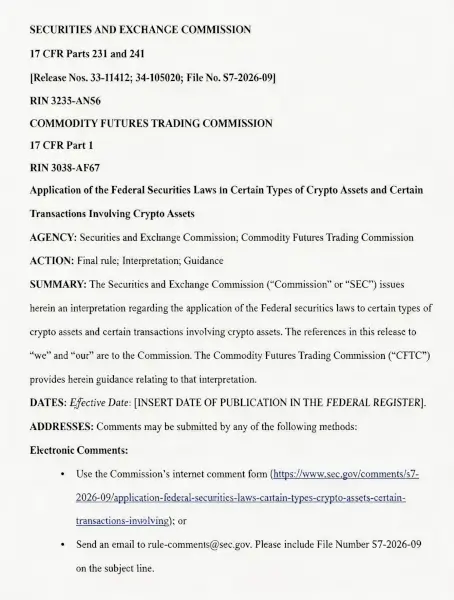
This document is not only a rare achievement of regulatory collaboration between the SEC and CFTC but also the most landmark guidance in the history of U.S. تشفير regulation. Below is an essential full-text interpretation:
I. Background: “Project Crypto” – From Conflict to Collaboration
In 2017, the SEC first applied the Howey test to crypto assets through *The DAO Report*. For the following decade, regulation primarily relied on enforcement actions to تحديne asset attributes, leaving the market in a prolonged state of uncertainty and controversy.
In early 2025, the SEC established the “Crypto Task Force,” subsequently launching the “Project Crypto” initiative co-led by SEC Chairman Paul S. Atkins and CFTC Chairman Michael S. Selig. The initiative aimed to coordinate the mandates of the two regulatory bodies, establish a unified asset taxonomy, and provide a clear path for crypto innovation to remain in the U.S. In January 2026, the project was formally upgraded to a joint SEC-CFTC action.
II. Asset Classification: The Logic of the “Five-Category” Framework for Crypto Assets
Based on asset characteristics, purpose, and functionality, the document divides crypto assets into five major categories, providing the market with clear classification standards for the first time:
- Digital Commodities
- Definition: Assets whose value derives from the programmed operation and supply-demand dynamics of a “functional” crypto system, not from the managerial efforts of others.
- Core List: The document explicitly names mainstream tokens such as BTC, ETH, SOL, XRP, ADA, DOT, AVAX, and LINK as digital commodities. These assets are not controlled by any single centralized entity and do not possess inherent economic rights to generate passive income.
- Digital Securities
- Definition: “رمز مميزized securities,” referring to traditional securities represented in crypto asset form, or digital assets possessing the economic substance of a security (e.g., representing enterprise ownership, dividend rights).
- Regulation: Regardless of being on-chain or off-chain, as long as the economic substance qualifies, they fall under SEC jurisdiction.
- Regulated Payment Stablecoins
- Scope: Stablecoins that meet the تحديnition of the 2025 *GENIUS Act* and are issued by authorized institutions.
- Qualification: These stablecoins are explicitly excluded from the definition of “securities” and are primarily regulated as payment instruments under specific laws.
- Digital أداةس
- Purpose: رمز مميزs with utility functions (e.g., access rights or service payments) only within specific crypto systems, typically not considered securities.
- Digital Collectibles
- Definition: Assets intended for collection and/or use, representing items such as art, music, videos, in-game items, or internet memes.
- Examples: CryptoPunks, Chromie Squiggles, WIF, VCOIN, etc.
- Qualification: Not securities in themselves; value derives from supply-demand relationships, not the managerial efforts of others. However, if fractionalized and sold, they may constitute securities.
III. Innovation: “Separation” and “Dynamic Transformation” of Security Status
This is the document’s most groundbreaking legal innovation—the SEC acknowledges for the first time that the “security status” of a crypto asset is not permanent.
“Separation” Mechanism
- Principle: A project may be deemed a security (investment contract) during its initial fundraising phase if it meets the Howey test. However, once the project completes its roadmap, achieves autonomous operation of open-source code, and decentralizes network power, the asset can be “separated” from the investment contract.
- Criteria: When investors no longer reasonably rely on the “essential managerial efforts” of the issuer for profit, but instead rely on the system’s own operation and market supply-demand, the asset transitions from a “security” to a “digital commodity.”
- Timing: Separation can occur immediately upon delivery of the asset to the purchaser or at a future date.
Three Scenarios for Separation
- Issuer Fulfills Promises: After completing essential managerial efforts, even if non-essential maintenance continues, the asset is no longer bound by the investment contract.
- Issuer Abandons Project: If the issuer publicly announces abandonment of development and ceases to fulfill promises, the asset falls outside securities law jurisdiction (though the issuer may still face legal liability for fraud).
- Secondary سوق Trading: If subsequent purchasers no longer reasonably expect to profit from the issuer’s efforts, the transaction does not constitute a securities transaction.
Transparency Recommendations
The SEC encourages project teams to publicly disclose roadmap progress and milestone achievements to help the market identify the “separation point.”
IV. Qualification of On-Chain Activities: “Demining” for Decentralization
Regarding long-debated activities like staking, mining, wrapping, and airdrops, the document provides extremely detailed and favorable interpretations:
Protocol Mining
- Qualification: PoW mining is an “administrative or ministerial” activity that secures the network and validates transactions.
- Conclusion: Neither solo mining nor joining a mining pool involves a securities offering.
- Mining Pool Operation: The activities of mining pool operators are administrative in nature and do not constitute essential managerial efforts.
Protocol Staking
- Qualification: Staking is an administrative activity that maintains network operation.
- Coverage: Includes solo staking, delegated third-party staking, custodial staking, and liquid staking.
- Custodial Staking: When a custodian stakes on behalf of users, as long as it does not involve re-lending assets, leverage, or discretionary trading, it does not constitute a securities activity.
- Ancillary Services: Supporting services like slash insurance, early unstaking, flexible reward distribution, and asset aggregation are all administrative in nature.
Staking Receipt Tokens
- Qualification: If the underlying asset is a non-security commodity and not bound by an investment contract, the receipt token itself is not a security.
- Principle: The receipt merely functions as a “receipt” and does not generate yield; yield originates from the underlying staking activity.
Wrapping
- Definition: Users deposit crypto assets with a custodian or cross-chain bridge, receiving 1:1 pegged, redeemable wrapped tokens.
- Qualification: If the underlying asset is a non-security commodity and not bound by an investment contract, wrapping is an “administrative function” aimed at enhancing interoperability and does not constitute a securities transaction.
- Key Restriction: The custodian must lock the assets and cannot lend, collateralize, or re-stake them.
إنزال جويس
- Qualification Breakthrough: As long as recipients do not provide money, goods, services, or other consideration, the “investment of money” element of the Howey test is not met.
- Applicable Scenarios:
- إنزال جويping to wallets holding a specific token, with no prior announcement.
- Rewarding early testnet users.
- إنزال جويping to eligible users based on application usage.
- Red Line: If recipients must provide services (e.g., social media promotion) in exchange for the airdrop, it may constitute a securities offering.
V. Consolidation of U.S. Leadership
The document concludes with a detailed analysis of its economic significance:
- Eliminating the “Chilling Effect”: By providing legal clarity, it reduces business stagnation caused by opaque compliance, encouraging crypto innovation to return to the U.S.
- Lowering Compliance Costs: Clear classification and separation pathways significantly reduce legal advisory and regulatory response costs for businesses.
- Enhancing سوق Transparency: The new framework requires more detailed disclosure during the “investment contract” phase, better protecting investors.
- Promoting Competition and Innovation: Clear rules will attract more issuers and entrepreneurs to the market.
- Improving Pricing Efficiency: Reducing price distortions caused by uncertainty.
VI. Historic Breakthrough in Regulatory Collaboration
Structurally, the document establishes a clear analytical path: first classify the asset, then assess the transaction structure, and finally analyze whether the investment relationship persists.
More importantly, this is a rare instance of coordination between the SEC and CFTC on crypto regulation. Previously, the two agencies had long-standing disagreements on defining “security vs. commodity.” This joint framework essentially provides a preliminary division for major asset categories, marking a shift in U.S. crypto regulation from a stage of “inter-agency jurisdictional competition” to a “unified-rule-based division of labor system.”
This 68-page document not only ends a decade of regulatory chaos but also establishes U.S. leadership in the global crypto regulatory landscape. For practitioners, it is a must-read “industry constitution”; for investors, a clear “rights protection مرشد“; for entrepreneurs, a definitive “compliance roadmap.”
The “Wild West” era of crypto assets has officially come to an end.
هذا المقال مصدره من الانترنت: U.S. Establishes “Five-Category Law” for Crypto Assets: A Guide to the New Regulatory Framework
Related: In-Depth Analysis of STRC: MicroStrategy’s New Magic Trick for Raising Funds to Buy Bitcoin
Compiled by | Odaily (@OdailyChina); Translator | Azuma (@azuma_eth) Over the past two weeks, we’ve seen a significant increase in STRC trading volume, alongside growing buzz about the product on social media platforms like X. Therefore, I believe now is a good time to write an article about Strategy and its new structure. This is my fourth article on Strategy and the Bitcoin treasury model: The first article introduced the Strategy playbook, where I clarified some common misconceptions about the model. The second article explained the “full-stack treasury company” model and the mechanisms supporting its NAV premium. The third article introduced the preferred share playbook, a new model launched by Strategy in 2025, which is now the company’s primary strategy. In this article, we will focus on STRC. It has…
相关文章































 العربية
  English
  繁體中文
繁體中文  简体中文
简体中文  日本語
日本語  Tiếng Việt
  한국어
한국어  Bahasa Indonesia
  हिन्दी
  اردو
اردو  Русский