







Four-Phase Scenario Analysis of US-Iran Conflict: Six-Week Inflation Tipping Point, July Buying Window
Original Compilation: TechFlow
Introduction: The context in which this analysis was written speaks for itself—the author wrote this four-phase market framework while evacuating his family in Oman and dealing with missile attacks.
He is not trying to predict the outcome but rather deducing the most likely viable middle path: 6 weeks is the critical point for inflation transmission, July-August is the buying window, and the Fed will be forced to cut rates in September.
This is one of the most information-dense and credible market analyses on the Iran war to date.
Full text below:
Over the past week, I’ve pieced together this analysis in between evacuating my wife and dealing with attacks in Oman. These are my current thoughts on how this war will affect markets over the next 6 to 12 months. I’m not making predictions, just trying to map out the most likely middle path so I can adjust as events unfold.
My goal has always been, like Thucydides: take my own risks, pursue understanding, and speak the truth clearly. When great powers collide head-on again, and we all feel the weight of uncertainty, my only focus is: as an individual investor, what do I do to protect my family?
I see four phases ahead.
Phase One
Denial. This is where we are now. What we’re seeing is volatility around presidential statements—the market moves with whatever he says when it opens. Everyone is desperate to believe this new Middle East war will be short. Powell is already assuring everyone this isn’t stagflation, all while watching Israel bomb the South Pars gas field and probably wanting to throw his phone across the room.
Phase Two
If the war continues, the six-week trigger point in mid-April will initiate this phase. By week six, the oil price shock from hitting energy infrastructure will have seeped into freight, food, and consumer goods. CPI data starts to look scary. Tech stocks start to feel real pain as valuation multiples begin to contract.
Tech valuations should fall—higher energy prices lead to hotter CPI data, which kills any remaining hope for Fed rate cuts. Powell has already started to tamp down these hopes, and April and May data will finish the job. This won’t change as long as Israel has a veto over our foreign policy. Israel is bombing South Pars, while the US is allowing Russia and Iran to sell oil on global markets, trying to stabilize energy prices.
The market will throw a tantrum when Powell finally extinguishes the last hope for rate cuts this year. And unlike every sell-off in the last 15 years, I’m not sure I can simply buy the dip and wait for the Fed to bail me out. The inflation we’ll see is supply-driven—from bombing gas fields and LNG terminals.
The Fed has a bunch of useless economics PhDs and a computer that prints money. They don’t have a team of petroleum engineers or an LNG processing facility in the basement. The Fed can’t fix this with monetary policy. So, tech valuations priced for rate cuts will be repriced for rates staying where they are, and everyone will be miserable heading into summer when they realize there’s no easy way out.
Phase Three
Summer arrives, targeting July to August. Companies start reporting earnings, and the damage we’re seeing on the ground starts showing up in real numbers. Corporate earnings miss. Unemployment rises. Against the backdrop of this war, the AI replacement of workers will only accelerate behind the scenes as companies need to cut costs to deal with higher energy inputs. Politicians will start to panic ahead of the November midterms.
Phase Three is the buying opportunity I’m waiting for.
The quality names on my shopping list should appear at a meaningful discount—by then everyone will be tired of it all, angry about rising costs and falling job security, and demanding action before the fall and the midterms. This will happen. We’ve gone from cost-cutting to flooding the zone like the Afghanistan war. The war isn’t even three weeks old, costs are already skyrocketing with no sign of slowing, and a few hundred billion is just the start. The Fed will eventually capitulate, politicians will ramp up fiscal support, and we’ll add another trillion-plus in debt to pay for Israel’s war. Just need to stay patient.
Phase Four
Late 2026 to 2027. The Fed capitulates, starts cutting rates, and everything bought in Phase Three starts to work. I think coming out of this crisis in Phase Four, there will be a heightened focus on energy independence and energy abundance. Both parties in Congress will sing the same tune. No one wants to be labeled as “blocking a solution to this pain” because people have seen firsthand how disrupting energy markets in one part of the world raises costs everywhere. And it gives them the reason and cover to cut rates, spend more, and create jobs.
The Iran war will highlight the necessity of controlling input factors, and I expect this to be positive for assets under US jurisdiction or at least within the Western Hemisphere. Against all this backdrop, AI will only accelerate. Companies facing margin pressure, rising energy and input costs will cut labor costs with AI as much as possible. These aren’t the companies typically thought of as AI or tech companies, but the productivity gains will show up in their margins in 2027 and beyond. Coming out of this war, the AI story isn’t just about the companies building AI, but about the companies adopting AI to survive. This is the structural shift I’m looking for this summer.
How This War Started
The war is nearing three weeks, and I still think most people underestimate the duration of this conflict. It’s not because I’m predicting the worst-case scenario—I’m trying to focus on the most likely middle path—but because the theological framework driving Iranian decision-making doesn’t respond to the incentives assumed by Western politicians and commentators.
The Shia tradition is built on the story of Husayn ibn Ali, the third Shia Imam, who knew he would die in the Battle of Karbala in 680 AD. Seventy-two companions against thousands, and he still went. In Shia theology, resisting injustice is an obligation, even when it’s unwinnable in a conventional sense. Failure and death are not failure; compromise in the face of overwhelming injustice is failure.
The way Israel and the US started this war is almost a perfect reenactment of the Shia Islamic origin story itself—diplomacy used as a tool of deception, they attacked while the Omani foreign minister announced a diplomatic breakthrough, assassinating Khamenei and his family. Just like Husayn was massacred after being promised safe passage.
That’s why no matter how many targeted killings Israel conducts—those men in residential areas with their families and civilians—the Iranians will not kneel. The Israelis know this, and they don’t care. Israel will bomb Tehran until it looks like Gaza and set the entire Middle East on fire. They have no problem with chaos. The US? I know I can’t.
Shia theology reframes suffering as confirmation of walking the path of righteousness. This goes back to the 7th century, when Arab tribes poured out of the Arabian Peninsula and began conquering parts of Rome and Persia. The Persians are an ancient civilization who saw their conquest by Arabs as an injustice, so Shia theology found a natural home in Persian identity.
The idea that Israel and the US can assassinate their leaders as if reenacting the Shia origin story, throw a few missiles at them, and then they’ll submit to a foreign power—when their entire history is built on resisting foreign powers for millennia—is absurd. We remain tragically ignorant of who we want to go to war with, have learned nothing from the failures of the Global War on Terror and the Ukraine war, and have handed foreign policy veto power to psychopaths.
Current Situation
It’s day 20, and the conflict has crossed the threshold into Phase Two’s energy cost seepage into the supply chain.
Yesterday, Israel struck Iran’s South Pars gas field, the world’s largest. Iran retaliated, severely damaging Qatar’s Ras Laffan LNG facility, also the world’s largest. QatarEnergy has declared force majeure on gas exports and shut down LNG production. Qatar accounts for about 20% of global LNG trade, with over 80% of that volume going to Japan, South Korea, China, and Taiwan. That supply is now offline, and restoration could take years. Israel’s Bazan refinery in Haifa—supplying 65% of Israel’s diesel and 59% of its gasoline—was also hit, along with other energy infrastructure across the Gulf.
On Qatar, I worked for five years in Ras Laffan Industrial City on pre-commissioning for LNG facilities. QatarEnergy (called QatarGas when I worked there) is vertically integrated. They own everything from the offshore gas fields to the LNG processing facilities, to the export terminals, to the fleet of LNG tankers.
These LNG processing facilities are behemoths. When built two decades ago, 250,000 workers showed up every morning in the industrial city’s heat, the construction site a forest of cranes. Starting these facilities, especially after damage repair, inspection, and systematic restart, is not a quick process. These gas processing plants are like small cities, costing tens of billions, with intricate systems, some components custom-ordered with lead times measured in years.
Once missiles and Shahed-136 suicide drones fly into these facilities, causing primary and secondary fragmentation damage, plus fires and blast waves, you have to meticulously inspect these systems and restart them in phases. Some systems operate at extremely high pressures; if you miss a damage point, it can lead to catastrophic failure.
If custom long-lead components are damaged, you’re waiting months or longer—waiting for new vessels to be built in China or Korea, shipped, unloaded at the docks, and escorted down the road by Mammoet heavy-lift teams.
I had hoped the damage at Ras Laffan was less severe, repairable in months, not years. Unfortunately, that doesn’t seem to be the case.
This has immediate knock-on effects for other industries. Qatar’s offshore gas is high in sulfur. QatarEnergy, like using the whole cow, separates liquid hot sulfur from the gas, makes sulfur pellets, and ships them out on bulk carriers for fertilizer, chemical products, cement, refinery products, etc. Once LNG goes offline, it starts triggering other cascading effects, the second and third-order impacts of which I’m not fully certain about now. The only certainty: if this lasts long enough, the global economy will start breaking in unexpected ways.
As Charles Gave says, the economy is the transformation of energy. As the energy the world relies on goes offline and stays offline, countries will scramble for other energy imports. Middle East energy producers going offline leads to higher global energy prices. This might be good for US energy exporters, but over time, higher energy costs get passed to consumers, and businesses that can’t get energy at higher prices will shut capacity and lay people off.
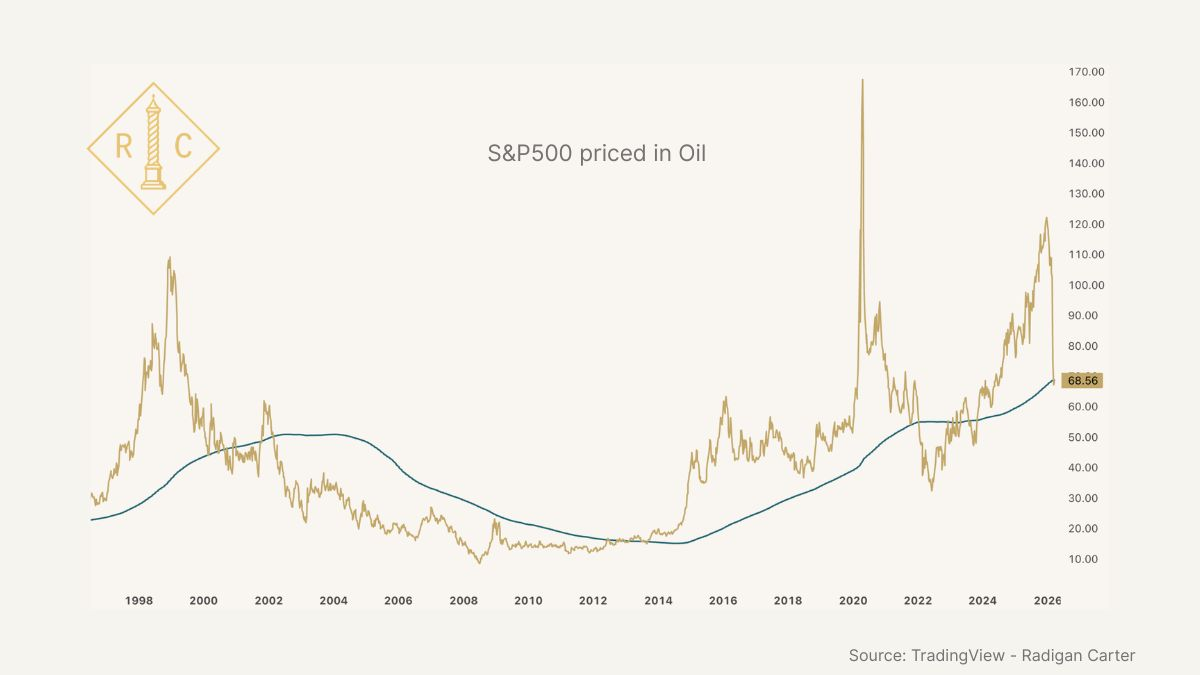
Chart: Heading for Inflationary Breakdown
Strait of Hormuz Crisis
Beyond hitting energy infrastructure, the conflict continues to spread regionally. Israel is invading southern Lebanon, killing another ~1,000 people and displacing nearly a million. Iraq’s Popular Mobilization Forces—Iran-backed Shia militias that played a key role in the 2016 fight against ISIS—are now engaged, attacking US facilities in Iraq, Saudi Arabia, Kuwait, and Jordan. This forces the US to withdraw and redeploy personnel from the region, further degrading the US military’s ability to sustain regional operations.
I’ve sailed through the Strait of Hormuz multiple times and previously wrote an article about the strait.
Since the war began, over 20 ships have been hit. The IRGC has launched 50 rounds of operations against US bases in the region. My read on this: from Adana in southern Turkey, south through Israel, and east to cover Lebanon, Syria, Iraq, the Arabian Peninsula, the Persian Gulf, and the Arabian Sea—the entire region is under Iran’s fire control.
If you include Yemen’s Houthis, then when the Houthis start hitting Red Sea shipping, global maritime and energy trade gets bifurcated. Historical analogies include: the Ottoman Empire closing the Silk Road, the shock to the global economy when WWI broke out in the summer of 1914, and the 1956 Suez Crisis showing the world the British Empire was over. That’s why I think, after coming out of this crisis in Phase Four, investors will look at their portfolios and seriously consider what this war revealed. Many might say: the profits are fine, but is the asset safe, in which jurisdiction? Assets in jurisdictions deemed safer, not needing to pass through treacherous chokepoints to reach end markets, might command a premium. The stakes of this conflict are that high.
Climbing the Escalation Ladder
Some ask, since Iran has fire control over the strait, why doesn’t the US start hitting life-support infrastructure. Further escalation, on top of targeted killings, regional spread, and now hitting energy producers, is not something to be taken lightly, no matter how much White House interns package this war as a video game and release despicable propaganda videos.
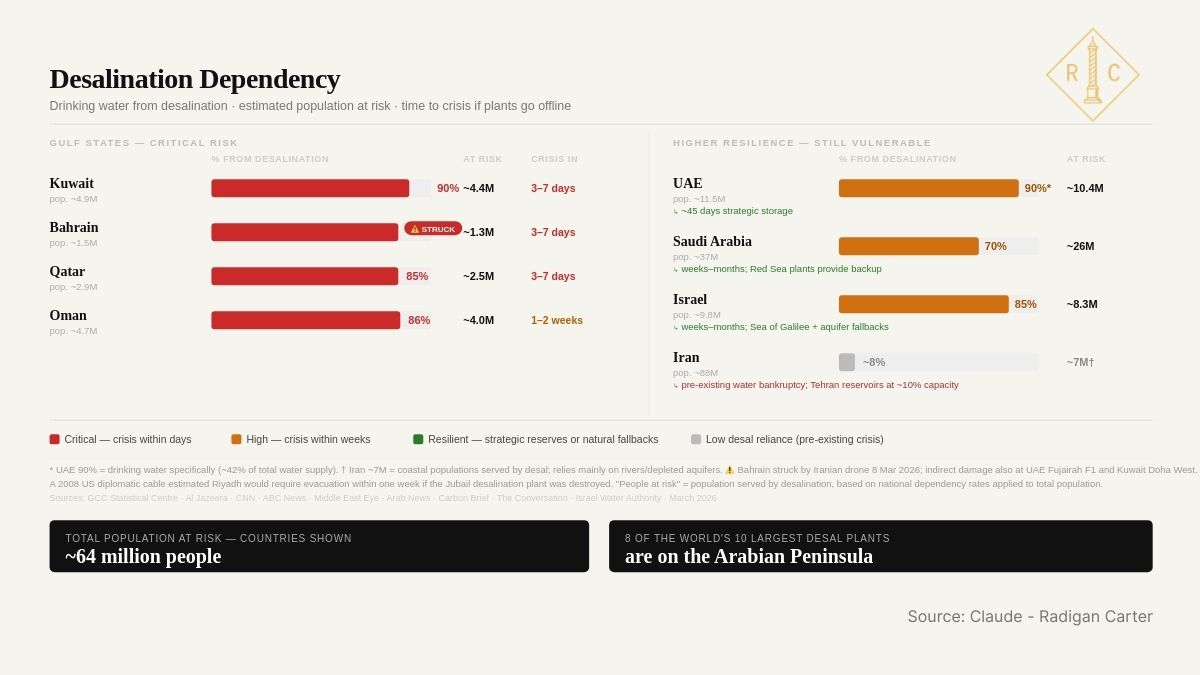
Unfortunately, we are already hitting life-support infrastructure. On day 7 of the conflict, the US struck a desalination plant on Iran’s Qeshm Island. This island is the key point guarding the Strait of Hormuz. Iran’s geology gives the island extensive natural caves, and the IRGC has spent decades improving and hardening underground facilities there.
The next day, Iran retaliated with equal escalation, sending attack drones to strike a desalination plant in Bahrain. Kuwait and the UAE have also reported missile-related damage to desalination plants. Losing desalination plants is an existential threat to Gulf states and Israel. With summer approaching and temperatures hitting 46°C, drinking water and power outages causing a humanitarian crisis and deaths is a real risk.
Over 90% of the Gulf’s desalinated water comes from just 56 plants. In Kuwait and Bahrain, desalinated water accounts for ~90% of national supply. In Oman where I am, it’s 86%, Israel 80%, Saudi Arabia 70%, UAE 42%.
If the US and Israel continue hitting life-support infrastructure, Iran will retaliate. As air defense intercept capabilities get depleted, hitting these facilities becomes easier, and this is an asymmetric vulnerability for Gulf states and Israel. About 64 million people in the region could be affected. This would trigger a humanitarian and refugee crisis dwarfing the Syrian civil war, with profound effects on Europe and Turkey.
Oil built the modern Middle East, but desalinated water keeps it alive. In this war, Iran has escalation dominance on both. The US needs energy to keep flowing from the Persian Gulf to stabilize global markets, and the region cannot lose its desalination plants. Israel can keep climbing the escalation ladder, but eventually they’ll reach the top, and Iran will then strike their desalination plants.
Phase Two: The Logic of the Six-Week Trigger Point
Everything so far has been Phase One—where we are now, why neither side can back down, and why the conflict is likely to persist. But Trump could announce a glorious victory on Truth Social tomorrow, the war ends, he made a fantastic deal—it doesn’t matter if it’s true.
It doesn’t matter if the Strait of Hormuz remains under Iranian control, or if the US had its own Suez moment—that has longer-term implications, but that’s another story. In that scenario, the important thing is whether higher energy costs fail to propagate to other parts of the supply chain in time, and this whole analysis can be thrown out.
When thinking, I asked myself: at what point does it no longer matter what is said, what agreement is announced, because higher energy prices are already flowing through the system and cannot be stopped
This article is sourced from the internet: Four-Phase Scenario Analysis of US-Iran Conflict: Six-Week Inflation Tipping Point, July Buying Window
1. CEX Hot Tokens Top 10 CEX Trading Volume and 24-hour Price Change: BTC: -1.15% ETH: -0.58% SOL: -0.66% XRP: -1.23% BNB:-0.03% PAXG:+0.56% DOGE: -1.5% SUI: -0.83% ZEC: -1.45% PEPE: -4.12% 24-hour Top Gainers (Data Source: OKX): CFG:+35.88% KNC:+29.54% SAHARA:+9.86% TRA:+5.95% HYPE:+4.9% CELR:+4.38% NEIRO:+4.3% JUP:+4.23% ORBS:+4.09% KMNO:+4.03% 24-hour Top Gainers – Tokenized Stocks (Data Source: msx.com): Verb Technology Company, Inc. – MSX:+4.18% EchoStar Corporation – MSX:+2.57% Destiny Tech100 Inc. – MSX:+2.25% Blink Charging Co. – MSX:+2.07% Eightco Holdings Inc. – MSX:+1.9% A-Mark Precious Metals, Inc. – MSX:+1.88% ASP Isotopes Inc. – MSX:+1.87% Hyperion Defi, Inc – MSX:+1.42% Mega Matrix Inc. – MSX:+1.34% Novartis AG – MSX:+1.32% 2. Top 5 On-chain Meme Coins (Data Source: GMGN): Lobster (BSC) Freedom of Money (BSC) memes (BSC) Habibi (BSC) Snow Lion (BSC) Headlines X…
Related articles






























 English
  繁體中文
繁體中文  简体中文
简体中文  日本語
日本語  Tiếng Việt
  العربية
  한국어
한국어  Bahasa Indonesia
  हिन्दी
  اردو
اردو  Русский