




Is the DA war coming to an end? Deconstructing PeerDAS: How can it help Ethereum reclaim “data sovereignty”?
At the end of 2025, the Ethereum community relatively quietly ushered in the conclusion of the Fusaka upgrade.
Looking back on the past year, although discussions about underlying technology upgrades have gradually faded from the market spotlight, many on-chain users have likely already felt a significant change: Ethereum L2 is becoming increasingly cheaper.
In today’s on-chain interactions, whether it’s a transfer or a complex DeFi operation, gas fees are often only a few cents or even negligible. While the Dencun upgrade and the Blob mechanism have played a crucial role in this, Ethereum is also completely bidding farewell to the era of “full download” data verification with the official activation of PeerDAS (Peer Data Availability Sampling), a core feature of the Fusaka upgrade.
可以说 what truly determines whether Ethereum can sustainably support large-scale applications in the long term is not just Blob itself, but more importantly, the next step represented by PeerDAS.
I. What is PeerDAS?
To understand the revolutionary significance of PeerDAS, we cannot simply talk about concepts; we must first look back at a key milestone in Ethereum’s scaling journey: the Dencun upgrade in March 2024.
At that time, EIP-4844 introduced a transaction model that carries blobs (embedding a large amount of transaction data into blobs), which allowed L2 systems to no longer rely on the expensive calldata storage mechanism and instead use temporary blob storage.
This change directly reduced Rollup costs to a fraction of what they used to be, ensuring that L2 platforms can provide cheaper and faster transactions without affecting Ethereum-based security and decentralization. It also allowed users to experience the benefits of the “low gas fee era”.
However, while Blobs are very useful, there is a hard limit to the number of Blobs that each block on the Ethereum mainnet can support (usually 3-6), for a very practical reason: physical bandwidth and hard drive space are limited.
In the traditional verification model, every validator in the network, whether it is a server operated by a professional organization or an ordinary computer in a home, still has to download and distribute the complete Blob data in order to confirm the validity of the data.
This presents a dilemma:
- If the number of blobs is increased (for expansion): the data volume will surge, the bandwidth of home nodes will be fully utilized, and their hard drives will be filled up, forcing them to go offline. The network will then be rapidly centralized and eventually become a giant blockchain that can only be run by large data centers.
- If the number of blobs is limited (for decentralization): the throughput of L2 is locked, making it unable to cope with future explosive growth in demand.
In short, Blob is just the first step, solving the problem of “where to store” data. When the amount of data is small, everything is fine, but if the number of Rollups continues to increase in the future, and each Rollup submits data at a high frequency, the capacity of Blob will continue to expand, and then the bandwidth and storage pressure on the nodes will become a new centralized risk.
If the traditional full download model continues, the bandwidth pressure cannot be resolved, and Ethereum’s scaling path will hit the wall of physical bandwidth head-on. PeerDAS is the key to unlocking this deadlock.
In short, PeerDAS is essentially a completely new data verification architecture that breaks the ironclad rule that verification must be done by downloading the entire data, allowing blobs to expand beyond current physical throughput levels (e.g., from 6 blobs/blocks to 48 or even more).
II. Blob solves the “where to put” problem, PeerDAS solves the “how to store” problem.
正如刚才提到的, Blob took the first step in scaling up and solved the problem of “where to store data” (moving from expensive Calldata to temporary Blob space). PeerDAS then needs to solve the problem of “how to store data more efficiently”.
The core problem it aims to solve is how to prevent the physical bandwidth of nodes from being overwhelmed as the amount of data expands exponentially. The approach is straightforward: based on probability and distributed collaboration, “it is possible to confirm the existence of this data with a high probability without requiring everyone to store the full amount of data.”
This can be seen from the fact that PeerDAS stands for “Peer-to-Peer Data Availability Sampling Validation”.
This concept may sound obscure, but we can understand this paradigm shift using a simple analogy. For example, in the past, full verification was like a library receiving a book of several thousand pages from the Encyclopedia Britannica (Blob data). To prevent loss, each administrator (node) was required to manually make a complete copy of the book as a backup.
That means that only people with money and free time (large bandwidth/hard drive space) can become administrators. Especially since this Encyclopedia Britannica (Blob data) will continue to expand and contain more and more content, ordinary people will be eliminated in the long run, and decentralization will disappear.
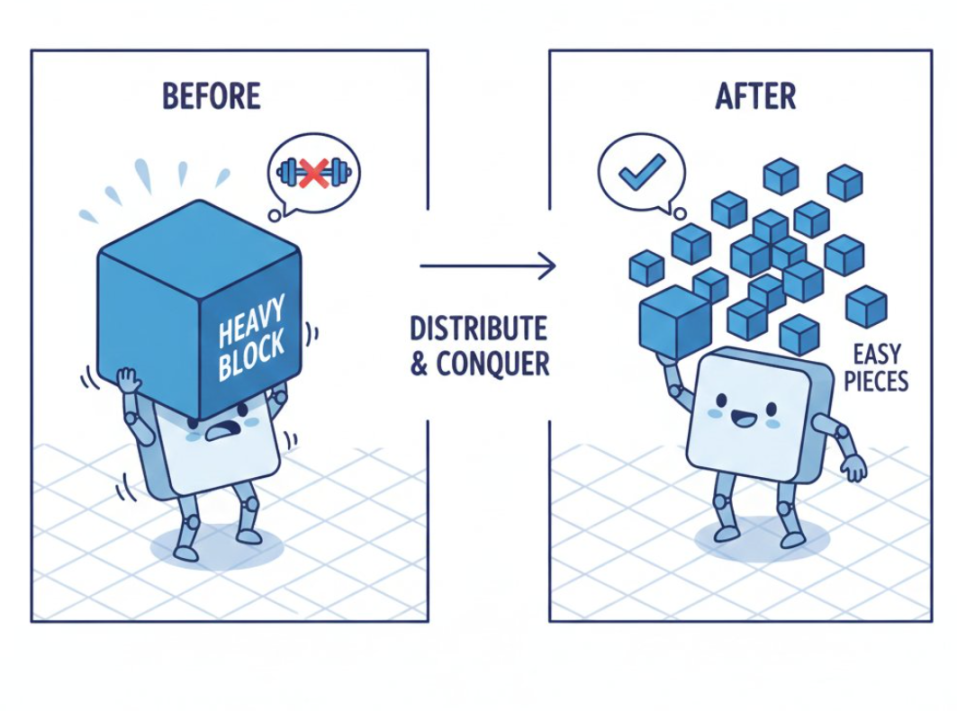
Now, based on PeerDAS sampling, technologies such as erasure coding have been introduced, which means that the book can be torn into countless pieces and expanded by mathematical coding. Each administrator no longer needs to hold the whole book, but only needs to randomly select a few pages to keep.
Even during verification, no one needs to present the entire book. Theoretically, as long as any 50% of the fragments are collected from the entire internet (whether everyone has page 10 or page 100), we can use mathematical algorithms to instantly reconstruct the entire book with 100% certainty.
This is the magic of PeerDAS— it relieves the burden of downloading data from a single node and distributes it across a collaborative network of tens of thousands of nodes.
 Source: @Maaztwts
From a purely data-driven perspective, before the Fusaka upgrade, the number of blobs was firmly capped at single digits (3-6). The implementation of PeerDAS directly broke through this ceiling, allowing the target number of blobs to jump from 6 to 48 or even more.
When a user initiates a transaction on Arbitrum or Optimism, the data is packaged and sent back to the mainnet. There is no longer a need to broadcast the complete data packet across the entire network. This allows Ethereum to achieve a leap where scaling no longer linearly increases node costs.
Objectively speaking, Blob + PeerDAS is the complete DA (Data Availability) solution. From a roadmap perspective, this is also a key transition for Ethereum from Proto-Danksharding to complete Danksharding.
III. The New On-Chain Normal in the Post-Fusaka Era
As we all know, in the past two years, third-party modular DA layers such as Celestia once gained a huge market space because Ethereum’s mainnet was expensive. Their narrative logic was based on the premise that Ethereum’s native data storage was very expensive.
With Blob and the latest PeerDAS, Ethereum is now both cheap and extremely secure : the cost of L2 publishing data to L1 has been cut by more than half, and Ethereum also has the largest validator set in the entire network, making it far more secure than third-party chains.
Objectively speaking, this is a devastating blow to third-party DA solutions like Celestia, signifying that Ethereum is regaining sovereignty over data availability and significantly squeezing their space for survival.
You might ask, these all sound very basic, so what does that have to do with my wallet, transfers, and DeFi?
The relationship is actually quite straightforward. If PeerDAS can be successfully implemented, it means that L2 data costs can remain low in the long term, Rollups won’t be forced to raise fees due to a rebound in DA costs, on-chain applications can confidently design high-frequency interactions, and wallets and DApps won’t have to repeatedly compromise between “features vs. costs”…
In other words, the fact that we can use affordable L2 today is thanks to Blob, and if we can continue to afford it in the future, it will be inseparable from the silent contributions of PeerDAS.
This is why, in Ethereum’s scaling roadmap, PeerDAS, though low-key, has always been regarded as an indispensable step. In essence, this is the best form of technology in my eyes—”benefiting without realizing it, and losing it would be difficult to survive,” making you unaware of its existence.
Ultimately, PeerDAS proves that blockchains can support massive amounts of Web2-level data through sophisticated mathematical design (such as data sampling) without excessively sacrificing the vision of decentralization.
With this, Ethereum’s data highway is now fully paved. The question now is what kind of vehicles will run on this highway.
Let’s wait and see.
This article is sourced from the internet: Is the DA war coming to an end? Deconstructing PeerDAS: How can it help Ethereum reclaim “data sovereignty”?
有关的: Airdrop Weekly Report | Monad will launch its public sale on November 17; Aster begins Phase 4, Aster Harvest (November
Author|Golem ( @web3_golem ) Odaily Planet Daily has compiled a list of airdrop projects available for claiming from November 10, 2025 to November 16, 2025, and also summarized important information about the airdrops during this period. See the main text for details. Pieverse Project and Air Investment Price Introduction Pieverse is an on-chain payment protocol that uses x402b to enable auditable, gas-free payments. The project announced the opening of airdrop applications on November 14th. Eligibility and allocation are based on a review of on-chain activity, interactions with the Pieverse platform, and other verified contributions. Early Pieverse users, Pieverse token holders, and users actively participating in activities are all eligible to receive the airdrop. Financing situation Pieverse has raised over $7 million in total funding. On October 24, 2025, it completed…
相关文章





























 简体中文
简体中文  English
  繁體中文
繁體中文  日本語
日本語  Tiếng Việt
  العربية
  한국어
한국어  Bahasa Indonesia
  हिन्दी
  اردو
اردو  Русский