







The First Step to Becoming an On-Chain Bank: Polymarket Launches Native Stablecoin
Author | Golem (@web3_golem)
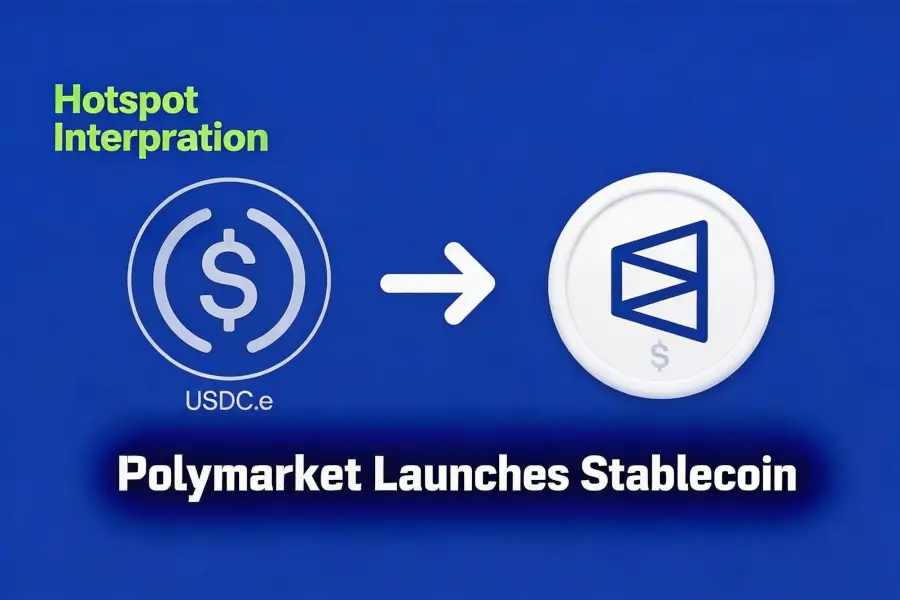
On April 6, Polymarket diumumkan a major platform upgrade scheduled for the next 2 to 3 weeks. This includes upgrading both CTF and CLOB to V2, and replacing the platform’s collateral from USDC.e to the native stablecoin, Polymarket USD.
According to the official introduction, Polymarket USD is backed 1:1 by USDC. For most users, the transition from USDC.e to Polymarket USD will be seamless, handled automatically by the frontend with just one confirmation click. The process might be slightly more complex for advanced users and API-only traders, but still not difficult. They will need to wrap their USDC or USDC.e into Polymarket USD using the wrap() function of the collateral access contract.
On the surface, Polymarket is merely changing the trading collateral in the backend. As the platform grows, continuing to use USDC.e indeed poses a potential risk. In February of this year, Circle and Polymarket had already announced plans to migrate bridged USDC.e to native USDC. This is just the normal progression of that cooperation.
However, Polymarket did not choose to directly introduce native USDC to replace USDC.e. Instead, it added another layer—a shell named Polymarket USD—with the purpose of depositing USDC into its own treasury pool. Therefore, the emergence of Polymarket USD can absolutely be considered a “One more thing” moment (Odaily Note: “One more thing” is a classic tradition of Apple product launches, now signifying a company’s grand finale or industry-disrupting move).
Polymarket Gains Minting Authority
The first layer of significance in this matter is that Polymarket can now retain user funds.
Previously, money deposited by users into Polymarket would become USDC.e. You can think of Polymarket as a massive trading venue responsible only for matching, pricing, and settlement. Money flowed through it, but the money itself did not belong to its system; Polymarket was not a treasury.
But that is about to change. By switching from USDC.e to Polymarket USD, Polymarket can now reach for that money which was merely “passing through.” As Polymarket officially stated, the daily user experience remains unaffected. However, the actual on-chain settlement path behind the scenes has been altered. This transformation is comparable to an exchange transitioning from relying on third-party clearinghouses to building its own clearing center.
Polymarket USD is backed 1:1 by USDC. This means that for every Polymarket USD in circulation, there will be an equivalent amount of USDC in Polymarket’s treasury pool. Currently, every Yes/No share pair on Polymarket is backed by USDC.e. When players place bets or settle, USDC.e also moves on-chain. But after switching to Polymarket USD, although it will similarly flow on-chain with user operations, the USDC in Polymarket’s treasury pool will not experience any movement. Therefore, as long as users do not redeem, this money is essentially owned by Polymarket.
Polymarket has gone from being a use case for a stablecoin to holding on-chain minting authority. Polymarket USD channels user assets from the “open sea” into Polymarket’s “inland lake.” Once funds begin to accumulate, Polymarket is no longer just a prediction trading platform. Its business model no longer relies solely on transaction fees, as it can now engage in the oldest game in finance: “making money from money.”
Expanding Polymarket’s Revenue Channels
The second layer of significance is the expansion of Polymarket’s business.
Currently, the business model of prediction markets is simple: charging transaction fees. After Polymarket adjusted its fee mechanism on March 30 (Odaily Note: Expanding the taker fee scope beyond the original Crypto and Sports categories to include Finance, Politics, Economics, Culture, Weather, and other market categories), its daily fee revenue has exceeded $1 million.
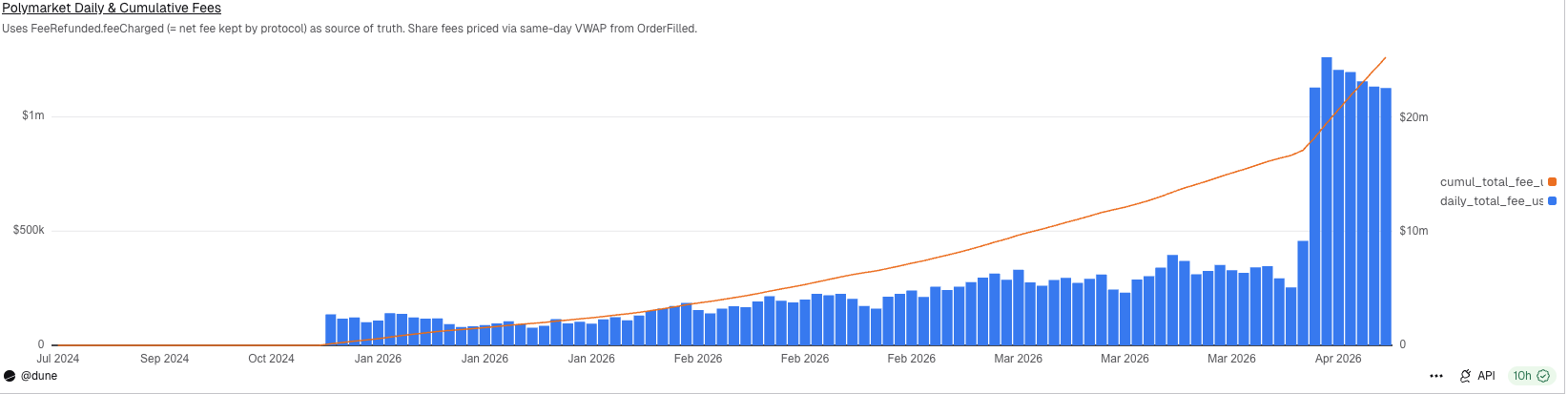
Polymarket’s Daily Fee Revenue
While impressive, this is not enough to satisfy Polymarket’s ambitions. Although prediction markets are currently the most sought-after sector, the ceiling for their business model is not particularly high. Project moats are also singular (regulatory approval), and user stickiness is not exceptionally strong. In the current landscape where everyone is entering the prediction market space, how can Polymarket ensure it won’t be surpassed by competitors in the future?
Now, its answer is: I don’t just facilitate trades; I can also activate players’ money.
From a business perspective, the most attractive aspect of stablecoins in recent years has never been fast payments and transfers, but the low-profile yet highly profitable money-printing machine behind them—reserve asset yield. In 2025, the vast majority of Circle’s revenue still came from reserve income. Polymarket understood this model, hence the launch of Polymarket USD.
According to Dune data, the total value of open interest on the Polymarket platform has exceeded $400 million. If all this money is converted to Polymarket USD, Polymarket simply needs to deposit the underlying collateralized USDC into Circle’s institutional accounts or place it in U.S. Treasury protocols. At a risk-free rate of 4%-5%, it could earn tens of millions of dollars in “interest tax” annually by doing nothing.
Defillama founder 0xngmi directly stated that there is approximately $1.25 billion in user wallets on Polymarket. If they retain this interest income, at current rates, they would gain an additional $54 million in annual revenue. Polymarket could even participate in DeFi yield farming with higher APYs, turning users’ idle funds on the prediction platform into active leverage and returning the generated yield to users, effectively providing them with a hedge.
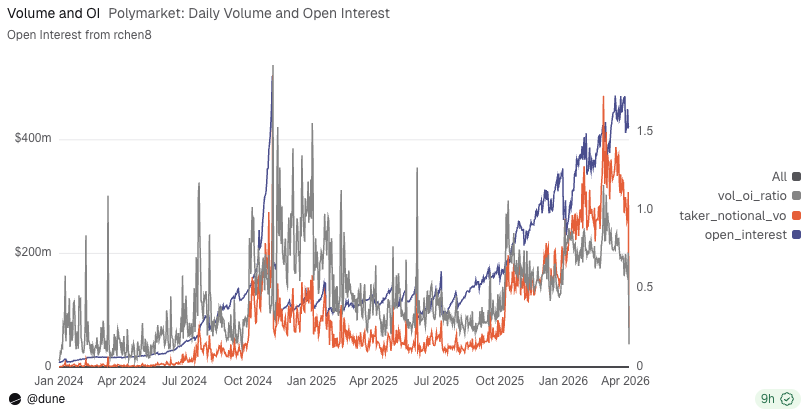
Polymarket’s Daily OI and Trading Volume Curve
Prediction markets inherently have two characteristics: fund retention and high-frequency reallocation driven by events. Users’ money doesn’t instantly enter and exit like in a casino. It’s either already in a position or sitting in an account waiting for the next event or odds change. This type of money is most suitable for financial reprocessing, and for users, there’s a beautiful justification: improving capital efficiency.
Of course, Polymarket has not yet publicly stated that it will definitely engage in yield extraction or on-chain wealth management after launching the stablecoin. But this path is almost a natural next step. As the scale of Polymarket USD grows in the future, it inherently gains the space for yield management, collateral expansion, and internal financial portfolio creation.
Recently, the CLARITY Act faced opposition for potentially prohibiting kripto businesses from offering interest on stablecoins to users. If the outcome of the dispute remains a ban, all the above potential of Polymarket USD would vanish. However, on April 6, according to U.S. media reports, the core disagreement between the U.S. kripto industry and banking sector over stablecoin yield mechanisms may be nearing resolution. Although details are not yet disclosed, overall expectations are optimistic, and the CLARITY Act may enter the committee review stage in late April.
So, don’t think Polymarket is far from this reality.
Polymarket Gains USDC Distribution Power
The launch of a stablecoin by Polymarket holds a third layer of significance: gaining USDC distribution power.
From today’s perspective, Polymarket remains a major distribution channel within the USDC ecosystem. Circle provides native USDC, Polymarket distributes it—a harmonious relationship. Polymarket is currently experiencing strong growth momentum. Undoubtedly, the USDC reserves accumulated within its platform will grow larger in the future, potentially becoming a distribution channel as important as Coinbase. When that time comes, the relationship between Polymarket and Circle might also change.
A reality in the stablecoin world is that distribution power is as important as issuance power. That’s why Coinbase can take over half of Circle’s reserve revenue. Therefore, in the future, when Polymarket becomes a significant USDC distribution channel, it will inevitably gain bargaining power and be entitled to a large share of the reserve revenue. Furthermore, when Polymarket USD matures sufficiently, it could explore multi-reserve backed stablecoins, not limiting itself solely to USDC.
This is also why I believe Polymarket USD is not just a routine upgrade for Polymarket, but an identity update. Polymarket will evolve from a “platform collecting fees based on event volatility” to one that also functions as a “platform organizing and clearing around the dollar.”
The former is casino logic, while the latter is bank logic.
Polymarket’s moat has thus gained another layer. It still maintains the elegant narrative of “information as market” and “pricing facts in advance.” But in terms of business model, it is quietly repositioning itself towards a more crucial role. It is no longer satisfied with being surface-level market traffic, no longer satisfied with attracting users solely through odds, and no longer satisfied with leaving the fattest part of the industry chain (asset reserve yield) to others.
Artikel ini bersumber dari internet: The First Step to Becoming an On-Chain Bank: Polymarket Launches Native Stablecoin
The project with the largest single financing amount this period was Bitcoin mining company Canaan Technology, which announced the completion of a $39.75 million financing round. The second largest was cryptocurrency trading platform STS Digital, which announced the completion of a $30 million financing round. Furthermore, against the backdrop of the continued popularity of prediction markets, an increasing number of projects focused on the prediction market niche are emerging in the investment and financing field. The specific financing events are as follows (Note: 1. Sorted by the announced amount; 2. * indicates “traditional” companies with partial business involving blockchain): Canaan Technology Completes $39.75 Million Acquisition of Cipher Mining Project Equity Financing On February 24, Canaan Technology announced the completion of a $39.75 million financing round. By issuing 806,439,900 Class A…
相关文章































 Bahasa Indonesia
  English
  繁體中文
繁體中文  简体中文
简体中文  日本語
日本語  Tiếng Việt
  العربية
  한국어
한국어  हिन्दी
  اردو
اردو  Русский