







The U.S. 82nd Airborne Division canceled its rotation at the “Joint Readiness Training Center.” The 82nd Combat Aviation Brigade, which typically moves by sea, was airlifted by transport aircraft. Blood bank reserves at U.S. military bases in the Middle East increased by 500%. The U.S. Department of Defense’s largest overseas hospital, the Landstuhl Regional Medical Center in Germany, suspended some civilian services.
The last time this combination of moves was seen was on the eve of the U.S. invasion of Iraq in 2003.

Just as tensions were at their peak, Trump suddenly posted that the U.S. and Iran had a “very, very good and productive conversation” and announced the U.S. would suspend military strikes on Iranian energy infrastructure for five days. At around 3:00 AM Beijing time on March 27, Trump posted again, extending the suspension of strikes until April 6.
This stark contrast between objective facts and Trump’s statements has added significant difficulty to analyzing the situation.
But beyond these public statements, there is another information channel known as “prediction markets,” which attempts to interpret the flow of funds as a way to understand event developments, offering the world a new perspective on information analysis.
And in recent days, this money has started to flow in the same direction.
Multiple Insider Accounts “Side” with an Impending Ceasefire
There is a prediction market event created just three weeks ago with trading volume exceeding $50 million: “Will the U.S. vs. Iran ceasefire before ___ month ___ day?” If two people with opposing views on this market can agree on a “probability,” a matched trade and corresponding event probability are formed.
The market’s definition of “ceasefire” is very clear: both sides publicly announce a halt to direct military engagement. Considering the escalating war situation mentioned earlier, most people would think that with all military indicators pointing towards escalation, a ceasefire is a low-probability event with slim hope.

As the public expects, the current probability of a ceasefire before April 30 is around 38%, while the probability before March 31 is only 5%. Many even believe this probability should be lower—those who “overestimate” the ceasefire probability are likely gamblers who haven’t even read recent headlines and are just “trying their luck.”
However, among these “gamblers,” six accounts appear extremely suspicious. Their total profit of $1.8 million comes entirely from accurately predicting the timing of the “U.S.-Israel strikes on Iran” and the “Israel-Hamas ceasefire” during 2025, as well as the outbreak of the current Iran conflict and the assassination of Iran’s former Supreme Leader Khamenei.
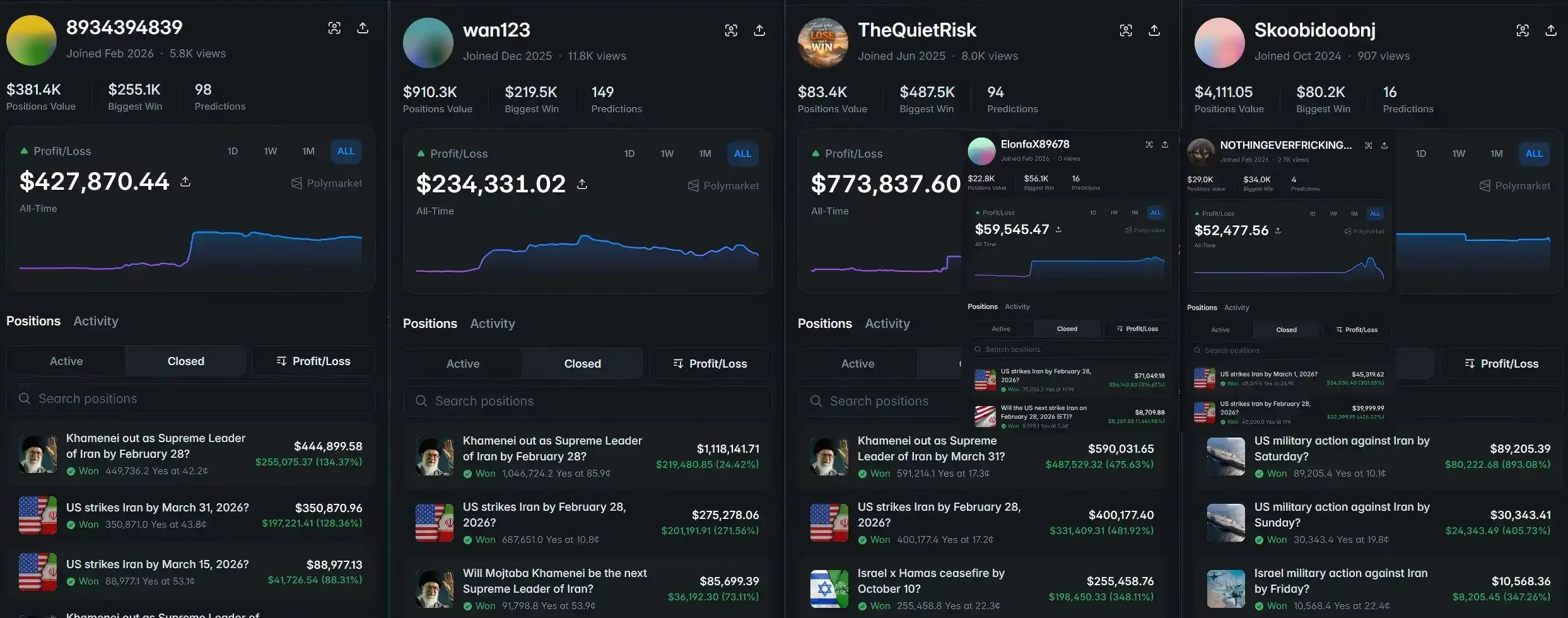
This series of uncannily accurate predictions is not their only commonality. As of March 27, they have cumulatively invested $285,000, betting firmly that the U.S. and Iran will cease fire before April 30, with $185,000 of that in the market for “U.S.-Iran ceasefire before March 31.”
If these six accounts can truly “foresee the future,” then we can inversely deduce the positions of both sides by “knowing in advance that a ceasefire is coming.”
Why Iran Wants a Ceasefire
This might be the moment when Iran has its strongest negotiating position and most chips in this war: the Strait of Hormuz blockade has pushed up global oil prices; aside from the U.S. and Israel, no other countries have directly participated in strikes; the resistance narrative and patriotic sentiment brought by the new leader have united the people.
Conversely, if the fighting continues, a series of countermeasures—such as the gradual shift of pro-U.S. Gulf states like Saudi Arabia and the UAE, the continuous depletion of Iran’s military capabilities, and the development of alternative routes to the Strait of Hormuz—will cause Iran to lose its dominant position at the negotiating table.

This brings up an extremely sharp question: on the eve of this war’s outbreak, the U.S. and Iran were negotiating in Geneva, with progress described by all sides as “productive” and even “a historic agreement within reach.”
However, while negotiations were still ongoing, the U.S. and Israel launched a surprise attack on Iran. With this precedent, how can Iran trust the U.S. to honor a ceasefire commitment?
This touches on the nature of the ceasefire itself: for Iran, a ceasefire is not a matter of trust but a calculation of interests. If the U.S. reneges after an agreement is reached, Iran will further solidify the narrative of “American perfidy” on the international stage. If the agreement is honored, Iran locks in the most favorable negotiation outcome available at present.
This also explains why, although Iran publicly stated it “will not negotiate,” it maintained communication through multiple intermediary channels and specifically put forward a counter-proposal. The public stance is a performance for the domestic audience, while the actual engagement is an effort to secure the best exit conditions.
Furthermore, Iran’s proxy network has suffered from organizational splits and ammunition depletion in this round of war. Coupled with its domestic economy being on the brink of collapse even before the war (the Iranian rial has depreciated by nearly 90% compared to 2018), quitting while ahead might be their optimal solution at the moment.
The U.S., Farthest from the Battlefield, Wants a Ceasefire the Most
Nearly a month into the war, the S&P 500 has been falling since before the conflict, and the Dow has closed lower for four consecutive weeks, marking its longest losing streak in three years. Gasoline prices have surged from $2.98 before the war to $3.98, a rise of over 30% in three weeks. The 30-year fixed mortgage rate has increased by a full half percentage point. Goldman Sachs has raised its recession probability to 30%.
These core data points have limited short-term impact on ordinary Americans, but for Trump, they are fatal—the stock market and WTI oil prices are core indicators of his governance performance.
And the U.S. government’s most ideal tool at this moment—the Strategic Petroleum Reserve (SPR)—is seeing its effectiveness significantly diminished due to aging infrastructure. Since this system, built after the 1975 oil crisis, was designed for a 25-year lifespan, its actual sustainable release capacity may be only half, or even less, of the official claims.
More critically, extracting crude oil further dissolves the internal structure of the salt caverns, meaning that large-scale releases themselves accelerate system aging. The SPR release card can indeed help Trump stabilize market sentiment in the short term narratively; but if the conflict drags on, the drawbacks of this countermeasure tool may manifest as a surge in oil prices on the charts.
Beyond financial data, U.S. domestic politics is also a factor Trump must weigh in this war. When the Iraq War began, George W. Bush’s approval rating was as high as 72%; when the Afghanistan War began, it was over 90%.
Yet on the first day of this war, Trump’s approval rating was below 40%. Even the classic political science phenomenon of the “rally ’round the flag” effect—where a president’s approval rating rebounds due to the outbreak of war—did not materialize in this round of strikes. As of March 25, Trump’s overall approval rating has fallen to 36%, a new low for his second term.
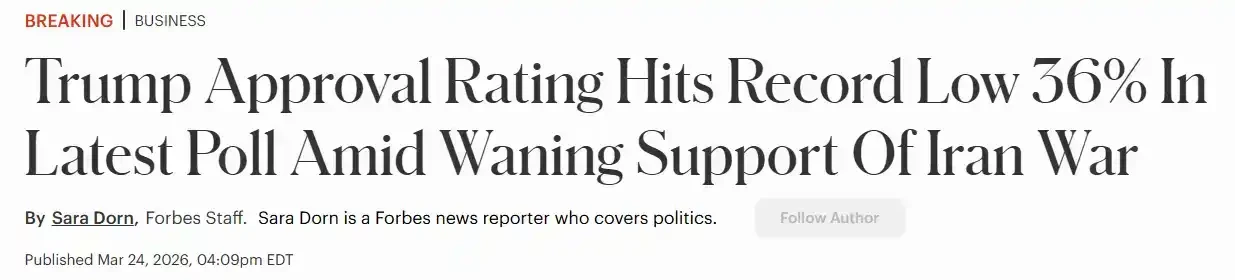
Coupled with his campaign promise of “No New Wars,” Trump’s current performance on the U.S. political stage not only jeopardizes the prospects of his core circle in the midterm elections later this year but is also eroding the entire Republican camp’s influence in the 2028 presidential election.
On the other hand, Trump has also set a hard deadline for himself: May 14. Citing the need to “remain in Washington to manage the current combat operations,” he postponed his planned visit to China next week and publicly stated yesterday that the trip would be delayed until May 14.
It is foreseeable that Trump needs to go to Beijing as a “winner,” not as a “president bogged down in the Middle East quagmire.”

Everything Changes, But TACO Doesn’t
There is now a term specifically describing Trump’s pattern of extreme pressure followed by a sudden announcement of favorable progress: TACO. It stands for Trump Always Chickens Out.
However, in the current tense geopolitical situation in the Middle East, many believe he will not TACO, and it’s even more unlikely he could successfully persuade Iran to agree to a ceasefire.
Three months ago, if someone told you that Trump would bring Venezuelan President Maduro back to a U.S. court like catching a chicken, use Greenland as a tariff bargaining chip to threaten European allies at the World Economic Forum in Davos, and kill Iran’s Supreme Leader while negotiations were ongoing—
All these events, previously considered to have less than a 1% probability, have happened. And the future we are now looking at is whether the extremely low-probability event of a U.S.-Iran ceasefire TACO in the next month will indeed play out as scheduled.
यह लेख इंटरनेट से लिया गया है: Insider Betting: Will Trump Ceasefire by the End of April?
According to a March 16th report by The Information, OpenAI has undergone a major restructuring of its Stargate computing infrastructure project, abandoning plans to build its own data centers and fully shifting towards leasing computing power from cloud service providers like Microsoft Azure, Oracle, and Amazon AWS. Stargate has been split into three functional teams, all managed under former Intel Chief Technology and AI Officer Sachin Katti. The direct reason for the shift is not complicated. Stargate was announced with great fanfare at the White House in January 2025, declaring a joint venture with SoftBank and Oracle to build large-scale data centers, with an initial investment of $100 billion and a total investment of $500 billion over four years. However, more than a year after the project’s launch, not a…
相关文章































 हिन्दी
  English
  繁體中文
繁體中文  简体中文
简体中文  日本語
日本語  Tiếng Việt
  العربية
  한국어
한국어  Bahasa Indonesia
  اردو
اردو  Русский